

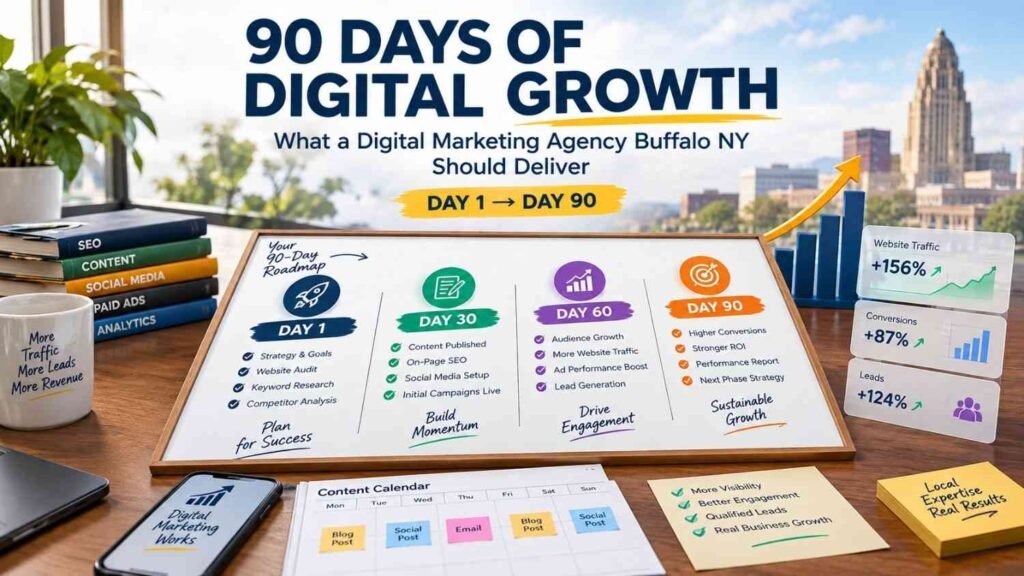
What Should a Digital Marketing Agency Buffalo NY Deliver in the First 90 Days? It is an important question for any business investing in professional marketing support. The first three months should not be filled with vague promises, unexplained reports, and a long wait for something to happen. While major results, especially from SEO services, can take longer, a good agency should still be able to show clear progress during the first 90 days.
The first few months should be the building blocks to sustainable growing success for Buffalo businesses. The agency must be familiar with the business, evaluate its current digital voice, identify opportunities, address priority issues, set up monitoring, and launch campaigns and measure customer response.
The specific services provided will be based on the business’s requirements, whether that involves SEO, paid ads, content marketing, social media marketing, website optimization, email marketing, or all of the above. But there are some things that businesses can reasonably expect in their first 30, 60, and 90 days.
This guide is designed to help you understand what these components should be like and how you can assess if your marketing partnership is going in the right direction.
Why the First 90 Days Matter
The first 90 days lay the groundwork for the relationship between a business and a marketing agency.
Without first having a clear grasp of the client’s objectives, an agency can drive traffic but not create meaningful opportunities for business. Similarly, if you spend weeks researching and never do anything, progress will be unnecessarily delayed.
In the first three months, there should be a balance between research and action.
During this period, a Digital Marketing Agency in Buffalo, NY should understand the company’s current situation, its desired direction, and the changes needed to achieve these goals.
The agency should also set up realistic expectations.
For example, a paid advertising campaign can start bringing in traffic fairly promptly, whereas organic SEO efforts will take longer to gain traction. An awareness of these variations will help avoid false expectations.
Days 1–30: Research, Strategy, and Setup
The first month should be spent learning the business so as to create the correct groundwork.
Establishing business discovery and objective setting.
1. Business Discovery and Goal Setting
The discovery process should include the company’s products or services, their target customers, their geographic service area, their competitors, pricing, the sales process, past marketing efforts, and the company’s growth goals.
The marketing tactics that a Buffalo roofing company employs would differ from those of a law firm, a restaurant, a dental office, or an e-commerce company.
This means that the agency should not be applying the same marketing approach to each and every client.
The goal needs to be quantifiable as well.
In lieu of just stating “More website traffic,” the business could focus on a targeted number of phone calls, estimate requests, online sales, consultation appointments, and appointment requests, etc.
These objectives will impact almost every marketing decision that comes next.
2. Complete Digital Marketing Audit
One of the first big deliverables should be a detailed audit.
The agency needs to assess the company’s current online footprint, looking for both positive and negative aspects.
The audit can include website, SEO performance, Google Business Profile, paid advertising accounts, social media, content marketing, email marketing, analytics and competitors – depending on the services that are in the agreement.
Issues with your website may be slow-loading pages, confusing navigation, weak service descriptions, broken links, poor mobile usability, or unclear calls to action.
Some of the common SEO issues include missing title tags, duplicate content, inadequate internal links, indexing problems, or pages that don’t align with customer search intent.
The important part is prioritization.
If the 100-page audit is not useful, then it’s because the business doesn’t know which 5 problems are the top priority.
3. Competitor Analysis
Businesses aren’t islands.
Your agency needs to recognize the big online players and study their successes.
They do not necessarily include your ‘traditional’ competition.
For instance, one company may not have as much of a physical storefront in Buffalo, but be more visible in Google search results due to better service pages, more helpful content, better local visibility, or having a better backlink profile.
Competitor research can reveal keyword opportunities, gaps in content, advertising strategies and places to stand out from the crowd.
The aim should not be to copy other companies. It is important to have a grasp on the digital market and opportunities that may have been overlooked.
4. Audience and Customer Journey Research
To market effectively online, we need to know the person behind the search.
What problems are customers trying to solve?
What questions do they ask before making a purchase?
What prevents them from contacting the company?
What information builds confidence?
These questions should be used to inform the message content, advertising, landing pages, and calls-to-action used by a Digital Marketing Agency Buffalo NY.
A person who is searching “how much does roof replacement cost?” is at a different level than one who searched “emergency roofer near me.”
Both searches can be useful, but they need to have different content.
5. Analytics and Conversion Tracking Setup
Marketing should be able to be measured for businesses for effectiveness.
The agency should verify that proper tracking systems are in place and functioning during the first month.
Important conversions could be:
- Phone calls
- Contact form submissions
- Appointment bookings
- Quote requests
- Purchases
- Email sign-ups
- Important landing-page actions
There are more than just vanity metrics that should be tracked; business outcomes should be tracked as well.
If no one visits the site, then thousands of views are of little use if they are not customers.
6. Establish Baseline Performance
The agency should record performance before making big changes.
This sets a reference for future comparison.
The report can contain traffic, search visibility, conversions, ad performance, cost per lead, engagement, Google Business Profile activity, or other indicators that are related to the strategy.
It’s hard to assess whether the next 90 days resulted in improvement without a baseline.
Days 31–60: Implementation and Campaign Launch
The strategy should start to become a tangible effort by the second month.
Research is still vital but there should be signs of improvement being put into practice in the business environment.
7. Website and Technical Improvements
The site issues that were determined as a priority during the audit should now be dealt with.
These could be anything from faster page loads, broken links, indexing issues, mobile optimization, easier navigation, or better calls to action.
Technical fixes: Prioritize fixes according to impact.
The agency doesn’t have to recode the whole website in the initial 60 days.
But if there are serious problems that will make important pages inaccessible to users or search engines, they should be addressed in a timely fashion.
8. On-Page SEO Improvements
If SEO is to be part of the campaign, important pages should start to be optimized.
This may be as simple as enhancing page titles, headings, meta descriptions, intra-links, image information, page structure, and content.
Use placement of keywords in a natural style.
Doing a dozen ‘Digital Marketing Agency Buffalo NY’ is not enough to make the page useful.
Content should respond to the actual inquiries from customers and be informative about what the company offers and where it’s located.
9. Local SEO Improvements
For businesses that cater to customers in Buffalo or the surrounding area, it’s a factor that is especially significant.
The agency can optimize the company’s Google Business Profile within the first 60 days, check the critical local citations, fix false and incorrect information, review categories, enhance service information, and create a system for getting authentic customer reviews.
The website must also be an effective communicator of relevant service areas.
Optimization for specific communities might be suitable for businesses with legitimate physical locations in more than one community.
Local SEO should concentrate on the real world and not on making dozens of pages that are almost the same for cities.
10. Content Strategy and Production
Content should be in the process of going from planning to production.
The content calendar could be used to plan future service pages, blog posts, guides, case studies, FAQs, social media content, and more.
The topics should be selected for business value and customer needs.
A Buffalo snow management company, for instance, would develop content on commercial snow contracts, ice management, property preparation for the winter season, and parking lot snow removal.
An article may be about the legal processes, some of the most frequent legal questions, types of cases, and preparation for consultations with a lawyer.
Valuable content can draw in traffic from search engines and enable prospective customers to make sound selections.
11. Paid Advertising Campaign Launch
Paid ads can be launched during this stage when all the necessary research, tracking, landing pages, and structures have been completed.
Some of the initial campaign work includes keyword selection, audience targeting, geographic targeting, ad copy, bidding strategy, negative keywords and conversion tracking.
The first run of an advertising campaign shouldn’t be viewed as a forever solution.
It should be improved based on performance data.
An agency should be tracking ad performance to see if the ads are reaching the right audience, or if they’re just wasting the budget.
12. Landing Page Improvements
Advertising money can be lost if you send traffic to a poor landing page.
The landing page should be easy to grasp and easily convertible to action.
These usually require an attention grabber, a brief summary, elements of trust, pertinent information about the service and a clear call to action.
Forms should ask for information to qualify a lead, but not so much as to cause unnecessary obstacles.
Mobile usability is particularly crucial as a large proportion of potential customers will be coming from their mobile devices.
Days 61–90: Optimization, Data, and Early Results
At the third month mark, the agency should have sufficient data to make more data-informed decisions.
This is the stage where the campaign is no longer in setup and initial implementation.
13. Review Early Campaign Data
The agency should examine the results of the initial changes and campaigns.
Which pages gained visibility?
Which advertisements generated conversions?
Which keywords attracted qualified visitors?
Which landing pages performed poorly?
Where are users leaving the website?
Answers can provide the basis for further improvements.
Effective marketing is a process of experimentation, study and modification, not a launching and leaving unaltered.
14. Optimize Paid Campaigns
Regularly check on paid campaigns.
At this point, the agency may have access to data to make changes to budgets, targeting, search terms, advertising, bidding strategies, or landing pages.
For example, a keyword generating many clicks but no qualified leads may need to be paused or refined.
There may be fewer clicks, but much greater conversions from another campaign.
The quality and cost of customers acquired by an agency is more important than the click volume.
15. Evaluate SEO Progress
Carefully review the progress made in SEO after 90 days.
For highly competitive keywords, it might not be possible to get high rankings if the website is new or not optimized yet.
But there must be some indication of work accomplished.
It could be a technical issue that’s been addressed, a key page optimized, new content added, local listings improved, more impressions, better indexing, a ranking shift in the early stages, better organic engagement, etc.
The agency should explain what has changed rather than simply saying, “SEO takes time.”
16. Improve Conversion Rates
But bringing more visitors is just a part of digital marketing.
Now, the question remains whether they turn into leads or customers.
An agency should start to identify conversion barriers in the third month.
Maybe users go to a service page and don’t fill out the form often.
Mobile users may leave a site if it takes too long to load.
Maybe mobile visitors abandon a page because it loads slowly.
These results can be put to practice to make things better.
Simply making the most of existing traffic, with some tweaks to the conversion process, can help to add some value to the traffic without needing to spend as much on advertising.
17. Deliver a Clear 90-Day Performance Report
After the first 90 days, the business should be provided with an understandable report.
A report should not just be a collection of charts without any explanation.
It should demonstrate what has been done, what has changed, what results made an appearance early on, what didn’t work out as planned, and what should happen next.
The types of reports that can be provided vary based on the strategy, including Traffic (organic), Conversions, Search Visibility, Paid Advertising Results, Cost per Lead, Local Visibility, Content Results, and other agreed metrics.
Wherever possible, the agency should tie metrics to business goals.
What Should the First 90 Days Look Like?
| Period | Main Focus | Expected Deliverables |
|---|---|---|
| Days 1–30 | Research and foundation | Business discovery, audit, competitor research, goals, analytics setup, conversion tracking and baseline report |
| Days 31–60 | Implementation | Technical fixes, SEO improvements, local optimization, content production, campaign launches and landing-page work |
| Days 61–90 | Optimization | Data analysis, campaign refinement, conversion improvements, SEO progress review and 90-day reporting |
The timeline will depend on the current digital footprint the company has, and the size of the business.
A company that begins with a strong website will be able to get into campaign execution quicker than a company that needs lots of technical repairs.
What Happens After the First 90 Days?
The 90 days are not a starting point.
Rather, the first quarter should give data that will help to guide the next phase of the marketing strategy.
The real-time data can help the agency understand which channels are working well, which ones need some tuning, which ones are worth pursuing further, which ones need some local SEO tweaking, which ones are worthy of new advertising strategies, and which ones could be improved to boost conversions.
In the next 90 days, the situations should be better informed than the initial 90 days.
This process of implementation, measurement and improvement can result in a more robust marketing system over time.
Final Thoughts
The first three months with a Digital Marketing Agency Buffalo NY should create more than a collection of reports. They should establish a measurable foundation for future growth.
During days 1–30, businesses should expect research, auditing, goal setting, competitor analysis, tracking setup, and a clear strategy. Days 31–60 should move into implementation through website improvements, SEO, content, local optimization, advertising, and landing-page work. By days 61–90, the agency should be analyzing real data, improving campaigns, addressing conversion barriers, and showing what has been accomplished.
Not every marketing channel will deliver dramatic results within 90 days, and responsible agencies should not guarantee outcomes they cannot control. However, businesses should be able to see completed work, understand where their marketing budget is going, and know what the next priorities are.
The strongest agency relationships are built on transparency, measurable goals, consistent communication, and continuous improvement. If those elements are in place by the end of the first 90 days, the business will have a much stronger foundation for the months that follow.
Frequently Asked Questions
01 How often should I meet with my digital marketing agency during the first 90 days?
Most businesses benefit from regular check-ins during the early stages of a campaign. Meetings may be weekly, biweekly, or monthly depending on the scope of work. The important thing is having a consistent schedule for reviewing progress, answering questions, and discussing upcoming priorities.
02 What information should I provide to a digital marketing agency during onboarding?
Provide accurate information about your services, target customers, service areas, competitors, previous campaigns, sales process, brand guidelines, and business goals. Giving your Digital Marketing Agency Buffalo NY complete information early can reduce delays and help the team create a more relevant strategy.
03 Should my marketing agency have access to my website and analytics accounts?
An agency may need appropriate access to platforms such as your website, analytics, advertising accounts, and business profiles to perform agreed services. Businesses should maintain ownership and administrative control of important digital assets while providing the agency with the level of access required for its work.
04 What should I do if I disagree with the agency’s marketing strategy?
Ask the agency to explain the reasoning and data behind its recommendation. A productive marketing partnership should allow both sides to discuss concerns openly. If your business priorities have changed, communicate those changes so the strategy can be reviewed accordingly.
05 How much content should a digital marketing agency create each month?
There is no ideal number for every business. Content volume depends on competition, budget, website condition, customer needs, and marketing goals. A few well-researched pages or articles can sometimes provide more value than publishing large amounts of thin content.
06 Should a Buffalo marketing agency understand my specific industry?
Industry experience can be helpful, but it should not be the only consideration. A capable agency should be able to research your market, understand customer behavior, follow industry advertising requirements, and develop a strategy suited to your business rather than relying on a generic template.
07 Can I change my marketing budget during the first three months?
Usually, budgets can be adjusted, although contract terms and advertising commitments may affect when changes are possible. Budget decisions should ideally be based on performance data, business priorities, seasonality, and the opportunities identified during the campaign.
08 How can I tell whether the leads generated by an agency are high quality?
Track more than the total number of leads. Consider how many inquiries come from your target service area, need services you actually provide, become appointments or estimates, and eventually turn into paying customers. Lead quality is often more valuable than lead quantity.
09 Should my agency provide access to the content it creates for my business?
Ownership and usage rights should be clearly addressed in your agreement. Before starting work, ask who owns website copy, graphics, advertising materials, landing pages, reports, and other marketing assets created during the relationship.
10 What should happen if a marketing channel performs poorly during the first 90 days?
A poorly performing channel should be investigated rather than automatically abandoned. Your Digital Marketing Agency Buffalo NY should examine targeting, messaging, landing pages, competition, budget, tracking, and lead quality. The findings can then guide whether the campaign should be improved, reduced, or shifted toward a better-performing opportunity.