
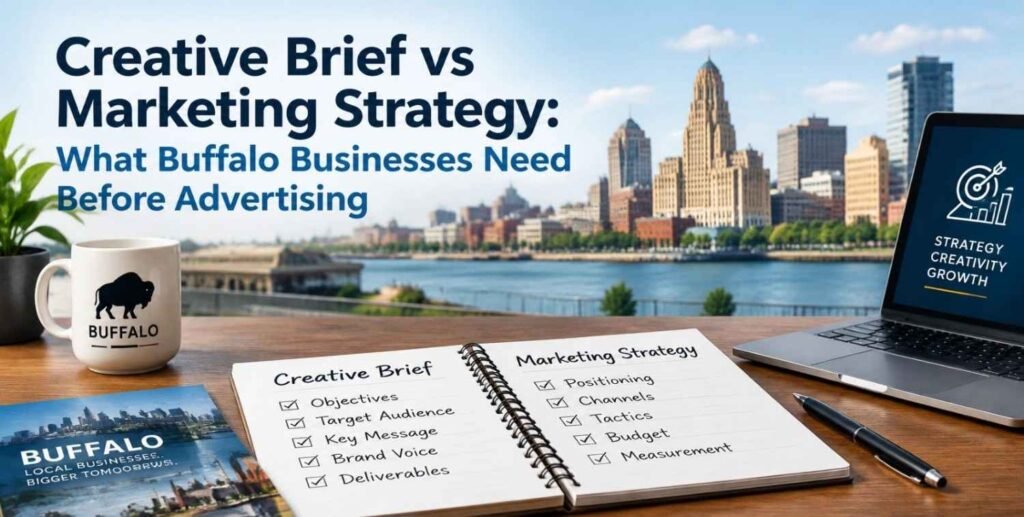
Creative Brief vs Marketing Strategy: What Buffalo Businesses Need Before Advertising is an important topic for businesses planning to invest in advertising. An interesting idea for a campaign and a good message and design do not mean that a campaign will be successful in marketing. If you’re planning to launch an advertising campaign, you should know the difference between a creative brief and marketing strategy. A marketing strategy is a plan that sets the direction for a marketing campaign by outlining business goals, target audience and appropriate advertising media. A creative brief, on the other hand, gives detailed directions on how to create and share a specific campaign. Some insight into how these two elements interact in advertising can help Buffalo businesses select the appropriate advertising media, control their budgets, and set expectations for creative groups. In assessing AD agencies in Buffalo NY, companies must take into account whether they possess strategic thinking and obvious creative direction within their advertising process.
What Is a Marketing Strategy?
A marketing strategy is a strategy that provides a long-term plan to explain how a business will reach its target audience, communicate its value to them, and meet specific business goals. It is the basis for all marketing channels, such as search engines, social media, paid ads, email marketing, and traditional media.
A marketing strategy takes into account the overall business context, rather than just one particular advertisement. It looks at the needs of the customer, the market and conditions, the competitor, positioning, and available resources.
For example, a business in Buffalo would be interested in more customers in the area. It could market itself by enhancing its local search presence, carrying out focused social media marketing campaigns, creating brand recognition, and driving quality leads.
The following points are commonly covered in a marketing strategy:
- Business objectives: What does the business want to achieve through marketing?
- Target audience: Which customers is the business trying to reach?
- Market research: What customer needs, industry trends, and competitor activities should be considered?
- Brand positioning: How should customers understand the business and its services?
- Marketing channels: Which platforms are suitable for reaching the intended audience?
- Budget allocation: How much should be invested in each marketing activity?
- Performance measurement: Which indicators will show whether the strategy is working?
A marketing strategy can assist a business in avoiding making marketing decisions just on trend or preference. It links individual campaigns with a measurable business objective.
What Is a Creative Brief?
A creative brief is a document that provides creative professionals (such as designers, copywriters and marketing teams) with the necessary information to create an ad campaign.
It turns the general marketing messages into specific creative directives. Rather than a detailed marketing plan, it concentrates on the message that a specific marketing campaign should be designed to convey and how the creative team should approach the campaign.
In this case, a Buffalo restaurant might want to highlight a new seasonal menu. Local citizens and nearby office workers may be significant audiences as identified in a marketing strategy. The creative brief would then cover the message of the campaign, the visual direction, the promotional elements, the formatting of the pieces, as well as the desired customer response.
Elements of a creative brief may include:
- Campaign objective: What should the advertisement accomplish?
- Target audience: Who should notice and respond to the campaign?
- Key message: What is the main idea customers should remember?
- Value proposition: Why should customers choose this business?
- Tone and style: Should the advertising feel professional, friendly, energetic, or informative?
- Creative requirements: What images, headlines, videos, designs, or written content are needed?
- Call to action: What should the audience do after seeing the advertisement?
- Deliverables and deadlines: Which advertising materials must be produced, and when are they required?
A creative brief helps to eliminate confusion among business owners and creative teams. It also assists in maintaining uniformity in the various advertising materials.
Creative Brief vs Marketing Strategy: Understanding the Difference
A creative brief is related to a marketing strategy, but they are not synonymous. They all have a different role to play in the advertising process.
A marketing strategy is what guides marketing efforts; a creative brief is what guides the creation of a particular campaign.
| Comparison area | Marketing strategy | Creative brief |
|---|---|---|
| Main purpose | Establishes the overall marketing direction. | Guides the development of a specific creative campaign. |
| Main focus | Business goals, customers, positioning, and channels. | Campaign message, design, tone, and deliverables. |
| Time frame | Often covers several months or longer. | Usually applies to one campaign or creative project. |
| Audience | Business owners, marketing managers, and decision-makers. | Designers, copywriters, content creators, and campaign teams. |
| Research | Includes market, customer, and competitor research. | Uses relevant research to guide creative decisions. |
| Budget | May outline the overall marketing investment. | May include the production budget or campaign-specific requirements. |
| Performance | Evaluates wider marketing and business outcomes. | Supports the creative elements being produced for the campaign. |
Both documents are essential as advertising requires a sound business direction and creative direction as well.
Why Buffalo Businesses Need a Marketing Strategy Before Advertising
When advertising is not backed up with a marketing plan, businesses can be distracted by attention-seeking advertising campaigns that do not yield business results.
A company may invest in social media ads, search campaigns or promotional videos, but not know what they are looking for in their customer. People may be clicking on the ads and viewing them but not making enquiries or making sales.
A marketing strategy enables businesses in Buffalo to make informed choices prior to investing in advertising.
1. It Identifies the Right Target Audience
Not all customers are appropriate for all businesses. A marketing strategy can be used to determine who the most likely customer base for a company’s products or services will be.
For example, A local home improvement company could specialize in homeowners in their service areas. A professional service provider can target any business owner, property manager or other organisation.
By understanding the target audience, businesses can choose the right advertising platforms, messages, and campaign formats to ensure that their ads are seen by the right people in the right place.
2. It Creates Clear Advertising Objectives
Advertising should support a specific purpose. Some campaigns are designed to build brand awareness; others are designed to build enquiries or to encourage customers to purchase products.
Before starting to develop a campaign, it is important to outline these objectives through a marketing strategy.
Some measurable advertising goals are:
- Increasing qualified website enquiries.
- Generating more phone calls from local customers.
- Increasing online purchases.
- Evaluating the awareness of a specific group of people.
- Promoting an event or promotion.
Having clear goals will make it simpler to evaluate the performance of the campaigns.
3. It Helps Businesses Understand Their Competition
One of the most common scenarios is that consumers can easily shop around, and Buffalo businesses compete with other providers to attract the attention of these consumers. To understand what the competition is doing might help a business find what makes its product or service different.
Competitor research can include: pricing strategy, advertising content, website visibility, consumer reviews, services offered, and promotions.
This information can be utilized to put businesses in a better position in the market, rather than saying the same thing as the competitors.
4. It Supports Better Advertising Budget Decisions
A marketing strategy enables companies to decide where to invest their advertising dollar.
A business might have to put money into local search engine optimization (SEO) first, before they raise their budget for paid search. For another company, a targeted landing page and social media advertising could be the perfect fit.
The right allocation is based on the target audience, campaign goals, competition, resources available, etc. Strategic planning ensures businesses aren’t paying for channels that are not in line with their priorities.
Why a Creative Brief Is Important for Advertising Campaigns
As a marketing strategy sets direction, the creative brief helps bring that direction to life as an advertising campaign.
In the absence of clear creative instructions, various team members might have different understandings of the campaign. A designer might want to highlight the beauty, whereas a copywriter might highlight another benefit. An inconsistent message may then be communicated in the final advertisement.
A creative brief lends itself to solving these issues.
1. It Keeps the Campaign Message Consistent
Each ad should convey the message. A creative brief is the key message that the audience must take away from the message.
In the case of an accounting firm in Buffalo, it could be their initiative to raise visibility for the importance of supporting small businesses. The aim of the brief is to clarify whether the focus of the campaign is on financial reporting, tax preparation, or ongoing support for the business.
This will help to ensure that the headline, images, and ad copy convey the same message.
2. It Gives Designers and Copywriters Clear Direction
To make an advertisement attractive, you need more than a general instruction and that is why creative professionals require more. They should learn what the campaign is about, who will receive it, what the message is, and what materials are needed.
A useful brief provides them with sufficient information to allow them to make creative decisions without needing to constantly seek clarification.
3. It Reduces Unnecessary Revisions
If the expectations are not clear, there could be several rounds of changes to the adverts. The business owner might not like the design, the message might be different from the business’s objective for the campaign, or key information may be missing.
A comprehensive creative brief sets good intentions prior to production. This can help to minimize misunderstandings, save time, and streamline the approval process.
4. It Helps Maintain Brand Identity
Consistency is required in businesses when it comes to the branding of their marketing. Colour, font, tone of voice, logo requirements and visual style may be specified in a creative brief.
Consistency is essential to make a business familiar to customers on various platforms and in various marketing materials.

How a Marketing Strategy and Creative Brief Work Together
The marketing strategy and creative brief are two elements in the same advertising process.
The strategy is the justification for the campaign and a brief is the development of the campaign. If they are aligned both creatively and strategically, then those decisions will have a better chance of meeting the actual objectives of the business.
Imagine a company that provides website building solutions in Buffalo, NY, is considering advertising them online.
Marketing strategy:
The business is looking to increase its number of qualified leads from SMBs in Buffalo. Its strategy is based on local search visibility, paid advertising, and educational content about the importance of professional website building.
Creative brief:
The creative brief is based on a single paid campaign. Identifies business owners as target audience, sets the main message, sets a professional visual style, and invites customers to ask for a website consultation.
The connection can be explained in the following way:
| Stage | Main activity | Expected outcome |
|---|---|---|
| Research | Understand the market, customers, and competitors. | Better marketing decisions. |
| Strategy development | Define goals, positioning, channels, and budget. | Clear campaign direction. |
| Creative briefing | Establish the campaign message and requirements. | Clear creative instructions. |
| Production | Develop advertising copy, images, videos, and designs. | Completed campaign materials. |
| Campaign launch | Publish advertisements across selected channels. | Campaign reaches the intended audience. |
| Performance review | Analyse results against campaign objectives. | Insights for future improvements. |
This is a process that enables the link between business planning and creative implementation.
What Happens When Businesses Advertise Without These Documents?
Some businesses start promoting as soon as they have an idea for promotion. Without a good sense of purpose or direction, they might post something on social media, run a paid campaign, or even make a video.
This way may appear to be quicker, but can cause issues down the road.
Unclear Campaign Objectives
If there is no marketing strategy in place, businesses might not be aware of the purpose of their advertisements, whether it’s to generate leads, build awareness, or drive sales. It’s hard to assess outcomes.
Inconsistent Advertising Messages
If there is no Creative Brief, various ads can convey different benefits or use different wording. Customers might not be able to comprehend the business.
Poor Audience Targeting
A campaign can reach individuals who may not be in the target audience for the product or service being offered. This can lead to advertising that gets engagement but few valuable enquiries.
Unnecessary Spending
Companies might invest in several platforms without knowing which ones are suitable for them for a certain goal. A strategy is used to focus on channels and campaign planning is used to ensure creative materials are appropriate for the chosen channels.
Difficult Performance Evaluation
Without clear objectives, the business could target the wrong metrics when running a campaign. If an advertisement gets a lot of impressions or clicks, it may not be bringing in any value to the company.
How AD Agencies in Buffalo NY Can Support Strategic and Creative Planning
The role of professional AD agencies in Buffalo NY can play in helping companies in the planning and production stages of advertising.
But companies need to know what they require prior to selecting an agency. Some providers might have a strong emphasis on creative production, whereas others may provide a wider range of services, such as market research, strategic planning, campaign management, and performance analysis.
When considering an advertising agency, the company needs to take into account a process that includes both the marketing strategy and the creative brief.
Marketing Research and Planning
An agency can assist in assessing the target market, the groups of customers that it would be beneficial to have, as well as the competitors that it will face, and its marketing position at the time.
This research supplies data which can be used to help with campaign goals and/or campaign channel selection.
Campaign Strategy Development
The agency might be able to assist in setting campaign goals, finding appropriate media, setting key messages, and determining how advertising activities will fit into broader business goals.
Creative Brief Development
A professional team is capable of converting strategies into definite creative directions. This may be in the form of campaign themes, advertising copy requirements, visual direction, brand guidelines, and calls to action.
Advertising Production
Based on the services that are provided, an agency might create graphics, videos, landing pages, social media ads, and other campaign materials.
Campaign Management and Reporting
Once the campaign is live, the agency can track the campaign performance and analyse impressions, clicks, conversions, cost per lead, qualified enquiries and more.
Exactly what services are provided will depend on the agency and on the agreement between the agency and the client. When starting a project, businesses should discuss deliverables and responsibilities, update frequency, and fees.
Questions Buffalo Businesses Should Ask Before Hiring an Advertising Agency
Making a decision on an advertising partner goes beyond looking at creative portfolios. It is important that businesses know the ways in which campaign planning, communication, production, and measurement work in an agency.
These are helpful questions to have when discussing it initially:
| Question | Why it matters |
|---|---|
| Do you develop marketing strategies before creating advertisements? | Helps determine whether the agency considers business objectives. |
| How do you research the target audience? | Shows how audience decisions are made. |
| Do you prepare a creative brief for each campaign? | Clarifies how creative work is organised. |
| Which advertising channels do you recommend? | Helps explain the agency’s approach to channel selection. |
| How do you measure campaign performance? | Shows whether results are evaluated against defined objectives. |
| What deliverables are included in the agreement? | Helps prevent confusion about the scope of work. |
| How often will we receive campaign updates? | Establishes communication and reporting expectations. |
The answers will assist businesses in determining if the agency’s workflow is suitable to their requirements.
Measuring the Success of Strategy and Creative Execution
A successful advertising process should be evaluated using measurable objectives rather than appearance or engagement alone.
The marketing strategy has an impact on what matters in the wider business outcomes. The creative brief is one tool that helps ensure that materials for a campaign convey the message and elicit the response that’s desired.
Businesses can check several performance measures.
| Metric | What it measures |
|---|---|
| Impressions | How many times an advertisement is displayed. |
| Reach | How many individual users are exposed to the advertisement. |
| Click-through rate | The percentage of impressions that result in clicks. |
| Conversion rate | The percentage of users who complete a desired action. |
| Cost per lead | The average advertising cost required to generate a lead. |
| Lead quality | How relevant and valuable generated enquiries are to the business. |
| Return on ad spend | The revenue attributed to advertising compared with the advertising cost. |
Not all metrics should be used in all campaigns. One could be about reach and impressions, another about qualified enquiries and cost per lead.
Analyzing creative performance and business results can help businesses understand what changes they should make in their next campaigns.
Conclusion
There is a difference between a creative brief and a marketing strategy, but they are related. The business objectives, target audience, positioning, and channels are set out in a marketing strategy and a creative brief provides the business with clear instructions on how to create a specific campaign. Businesses in Buffalo that grasp this difference can plan their advertising campaigns better, establish their goals more clearly and effectively use their marketing dollars. When considering hiring an AD agency in Buffalo NY, it’s important for businesses to figure out if they require strategic assistance, creative production, or both. Defining a strategy first and shaping the creative brief second can establish a more structured approach to advertising, leading to more focused campaigns with an impact on relevant business objectives.
Frequently Asked Questions
01 What is the main difference between a creative brief and a marketing strategy?
A marketing strategy defines the overall business and marketing direction, while a creative brief explains how a specific advertising campaign should be developed.
02 Does a business need a marketing strategy before advertising?
A marketing strategy helps businesses define their audience, objectives, positioning, and advertising channels before investing in campaigns.
03 What information should a creative brief include?
A creative brief should include the campaign objective, target audience, key message, tone, visual direction, deliverables, deadlines, and call to action.
04 Can a creative brief replace a marketing strategy?
No. A creative brief guides creative production, but it does not replace the wider planning and business decisions covered by a marketing strategy.
05 Who prepares a creative brief?
A business owner, marketing manager, or advertising agency may prepare the brief, often in collaboration with the people responsible for the campaign.
06 Why should Buffalo businesses plan before launching advertisements?
Planning helps businesses identify suitable audiences, establish campaign objectives, manage budgets, and select advertising channels more effectively.
07 How do AD agencies in Buffalo NY help with advertising strategy?
Depending on their services, agencies may support market research, campaign planning, creative development, advertising management, and performance reporting.
08 How often should a marketing strategy be reviewed?
Businesses should review their strategy regularly and update it when customer needs, competition, business objectives, or market conditions change.
09 What happens if an advertising campaign has no creative brief?
Without a clear brief, creative teams may misunderstand the campaign message, produce inconsistent materials, or require additional revisions.
10 How can businesses measure advertising campaign performance?
Businesses can review relevant indicators such as conversions, qualified leads, click-through rates, cost per lead, and return on advertising spend.