
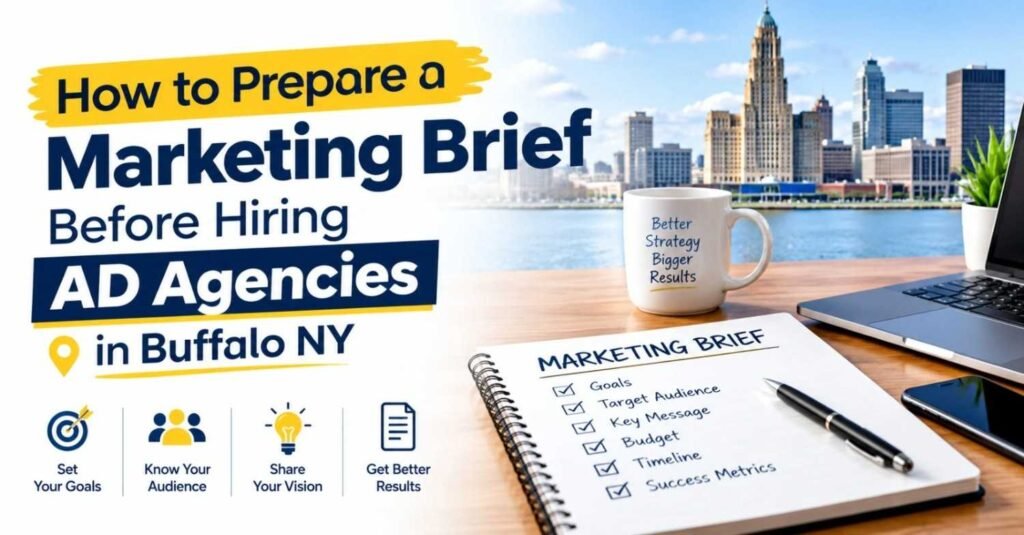
How to Prepare a Marketing Brief Before Hiring AD Agencies in Buffalo NY is an important step for businesses that want better results from their advertising campaigns. A clear marketing brief helps an agency understand what the business needs, who it wants to reach, what products or services it wants to promote, and what it expects from the campaign. Without a clear brief, businesses and advertising agencies may have different ideas about goals, budgets, target customers, and campaign priorities.
A marketing brief doesn’t have to be difficult. It should provide sufficient data to the agency to enable it to formulate the proper advertising plan for the business. Some companies may require Google Ads, social media ads, display ads, remarketing, or any mix of ads; having the proper information ready before your initial meeting can save time and eliminate confusion.
What Is a Marketing Brief?
A marketing brief is a document that outlines key points of an ad or marketing project. It provides an agency with a clear foundation as they start campaign planning.
The brief can include information such as:
- Business background
- Marketing goals
- Target audience
- Products or services
- Geographic areas
- Advertising budget
- Preferred platforms
- Competitors
- Previous campaign results
- Key selling points
- Campaign timeline
- Expected results
The paper doesn’t have to be a lengthy document. Where there is a one-page brief, it needs to be specific and realistic, and it can be useful.
Why a Marketing Brief Matters Before Hiring an Agency
Sometimes, companies reach out to an ad agency and state that they need additional customers or additional sales. This is a great goal but isn’t enough for a campaign to be effective.
A marketing brief is a tool that can answer some vital questions before advertising starts.
For example, an agency needs to know whether the business wants:
- More phone calls
- More website leads
- Online sales
- More store visits
- More bookings
- More quote requests
- Greater brand awareness
- Better local visibility
There are different types of campaigns for different objectives. A campaign aimed at getting phone calls can be different than a campaign aimed at boosting online sales.
Start With Your Main Business Goal
When reaching out to AD agencies in Buffalo NY you should have a clear idea of the goal you’re looking to achieve. Instead of writing “increase sales,” try to make the goal more specific.
For example:
Create 50 leads within the Buffalo area that are qualified leads.
A specific goal provides the agency with a target to achieve.
Your goal could be based on:
| Business Goal | Possible Advertising Objective |
|---|---|
| Increase leads | Generate quote or contact form submissions |
| Increase calls | Generate qualified phone calls |
| Increase sales | Generate online purchases |
| Increase bookings | Generate appointment requests |
| Build awareness | Increase local reach and impressions |
| Promote a new service | Drive targeted traffic to the service page |
| Enter a new market | Reach customers in a specific location |
Having one main goal also prevents the campaign from trying to achieve too many things at once.
Describe Your Business Clearly
The agency must first know what your business is before making advertisements.
Include a short description of:
- What your company sells
- Main products or services
- Years in business
- Main service areas
- Typical customers
- What makes your company different
- Your strongest products or services
Another example is that a Buffalo roofing company might claim that it repairs, replaces, inspects, and provides storm damage protection for Buffalo and surrounding homes.
This information is used to inform the agency on what services they need to be advertising the most.
Define Your Target Audience
The target audience is one of the most crucial components of a marketing brief. Your audience should be more specific than “people in Buffalo.”
Consider:
- Age range
- Location
- Income level
- Homeownership status
- Industry
- Job role
- Buying needs
- Common problems
- Buying behavior
- Preferred services
Residence might be especially crucial for local businesses.
Consider targeting customers in Buffalo, Amherst, Cheektowaga, Tonawanda, Williamsville, or other surrounding areas instead of the entire area.
Explain Your Ideal Customer
With an optimum customer profile in place, the marketing brief can be more useful.
For example:
Ideal customer: Homeowners, 30-65 years old, in Buffalo and its surrounding areas in need of roof repairs or replacement.
You can also provide reasons why these customers will purchase.
For example, customers may be:
- Dealing with storm damage
- Planning a home renovation
- Experiencing a leaking roof
- Looking for an emergency repair
- Comparing local contractors
If the agency is more familiar with the customer, it is easier to create effective advertising messages.
Identify the Services You Want to Advertise
Not all services should be promoted at once. Make a list of the most critical services and prioritize them.
For example:
- Roof replacement
- Roof repair
- Emergency roofing
- Roof inspection
- Storm damage repair
This enables the agency to comprehend the most valuable services to the business.
You can also give an average value for each service. A much higher-revenue service can have a different advertising budget than a low-cost service.
Explain Your Unique Selling Points
Your ads must have a motive for customers to pick your company. Write down the areas of your business that are best suited for its competition.
These may include:
- Years of experience
- Licensed professionals
- Certifications
- Warranties
- Free estimates
- Fast response times
- Local experience
- Positive customer reviews
- Specialized services
- Competitive pricing
- Financing options
Don’t just claim your business offers “high-quality service”. Whenever possible, attempt to give specific evidence.
For instance, if you say “excellent customer service” you don’t get anywhere as quickly as you do with “24/7 emergency response.”
Set a Realistic Advertising Budget
An estimated advertising budget should be incorporated into your marketing brief.
There are two different costs that can be budgeted:
- Ad spend: This is the amount of money spent on advertising platforms.
- 2. Agency fees: Money paid to the agency for strategy, management, creative work, reporting, or other services.
It makes the budget more understandable to keep these costs separate.
For example:
| Budget Area | Example |
|---|---|
| Google Ads spend | $2,000/month |
| Social media ad spend | $1,000/month |
| Agency management | $1,000/month |
| Creative production | $500/month |
| Total estimated marketing cost | $4,500/month |
These are just sample numbers. The correct budget will depend on the industry, competition, location, campaign objectives, and value of customers.
Decide Which Advertising Platforms Matter
You do not necessarily need to choose every advertising platform before hiring an agency. However, it helps to explain where you currently advertise or where you are interested in advertising.
Possible channels include:
- Google Search Ads
- Google Display Ads
- YouTube advertising
- Facebook advertising
- Instagram advertising
- LinkedIn advertising
- Local advertising platforms
- Remarketing campaigns
It is from there that the expertise of an experienced agency can come in handy in suggesting the best channels for your audience and goals.
Share Your Previous Advertising Results
If your business has already conducted advertising campaigns, be sure to add the results that are available in the brief.
Useful information could contain:
- Monthly ad spend
- Number of leads
- Number of calls
- Number of purchases
- Cost per lead
- Conversion rate
- Click-through rate
- Best-performing campaigns
- Poor-performing campaigns
- Landing pages used
This information provides the agency with a starting point rather than having to work without historical information.
If prior campaigns weren’t successful, describe what went wrong. It can help the agency not make the same mistakes.
Include Your Website Information
Your website can be a key component of an advertising campaign. Add your website URL and specify the pages to promote.
For example:
- Homepage
- Service pages
- Product pages
- Contact page
- Booking page
- Landing pages
- Location pages
If you know for certain that a specific landing page is successful in converting, include that in the brief.
Additionally, any major website redesigns should be communicated with the agency, as this can impact campaign planning and tracking.
Explain Your Geographic Targeting
Geographic targeting is important and needs to be communicated to local businesses. Rather than just the word “Buffalo,” specify the region you wish to serve.
Your brief should include details about:
- Primary city
- Nearby suburbs
- Counties
- Service radius
- Areas you do not serve
This can help prevent advertising money from being spent on people outside your actual service area.
A local service company might, for instance, concentrate on customers in the 25-mile radius in and around Buffalo, instead of all of Western New York.
Research Your Main Competitors
No need to develop an extensive competitor report before reaching out to an agency. Just enter the names or URLs of a couple of competitors. You can also state your preferences or disapproval of their advertising.
For example:
- Competitor has strong Google visibility
- Competitor uses video advertisements
- Competitor promotes free estimates
- Competitor has strong customer reviews
- Competitor appears frequently for important local searches
This provides the agency with some valuable market background.
Explain Your Brand Style
Your agency should know how you want to communicate with your customers.
Include information about:
- Brand colors
- Logo
- Fonts
- Tone of voice
- Preferred images
- Words you want to use
- Words you want to avoid
- Existing brand guidelines
For example, a law firm might require a more professional and trustworthy tone, while a restaurant could opt for a more informal and approachable tone. Advertisements should be consistent, as they need to be a part of the business.
List Important Campaign Messages
Consider the message your customers should take away from your ad. Your brief can include three to five key messages.
For example:
- Locally owned business
- Free estimates
- Fast response
- Experienced team
- Flexible appointment times
These ideas can be reused in headlines, descriptions, graphics, videos and landing page messaging for the agency.
Define What Counts as a Conversion
An action that is important to your business is considered a conversion. Don’t believe all clicks are worth the same.
The type of conversions you can expect to see varies by business, but they may include:
- Phone calls
- Contact forms
- Quote requests
- Online purchases
- Appointment bookings
- Store visits
- Downloads
- Email sign-ups
Communicate to the agency which actions are the most critical. This will also aid in the selection of tracking systems to be installed.
Ask About Tracking Before Campaign Launch
Measuring advertising is a prerequisite for good advertising. When outsourcing, ask what will be measured for campaign success.
Some tracking areas of importance may be:
- Website form submissions
- Phone calls
- Online purchases
- Booking forms
- Landing page conversions
- Campaign source
- Keyword performance
- Ad performance
You should also understand how often reports will be provided and which metrics will be included.
Set a Campaign Timeline
Make sure to include key dates in your brief.
For example:
| Timeline | Activity |
|---|---|
| Week 1 | Agency research and strategy |
| Week 2 | Creative and campaign preparation |
| Week 3 | Tracking and testing |
| Week 4 | Campaign launch |
| Month 2 | Performance optimization |
| Month 3 | Strategy review |
The period it takes will vary depending on campaign size and complexity. Having a clear timeline in place is beneficial to everyone to understand what should be done before and after launch.
Decide What You Expect From the Agency
When you’re considering hiring an agency, you should consider the sort of support you want.
An agency can help supply the following:
- Campaign strategy
- Keyword research
- Ad copywriting
- Graphic design
- Video creation
- Campaign management
- Conversion tracking
- Landing page recommendations
- Monthly reporting
- Performance reviews
Identifying the services you need early can make hiring easier, as not all agencies will offer them.
Questions to Ask AD Agencies in Buffalo NY
When the time comes for agency interviews, refer to your brief.
The following are some helpful questions:
- Have you worked with businesses in our industry?
- How do you determine the right advertising channels?
- How will you measure campaign success?
- What will you include in monthly reports?
- How often will campaigns be optimized?
- Who will manage our account?
- How do you approach audience targeting?
- How do you handle poor campaign performance?
- What information do you need from our business?
- How do your agency fees work?
The solutions will enable you to understand and compare agencies on strategy in addition to price.
Red Flags to Watch for When Hiring an Agency
A marketing brief can also be used to weed out agencies that may not be right for your particular needs.
Be careful if an agency:
- Promises guaranteed sales
- Cannot explain its reporting process
- Avoids discussing tracking
- Does not ask about your target audience
- Focuses only on clicks
- Cannot explain where your advertising budget goes
- Provides vague answers about campaign strategy
- Does not discuss conversion goals
- Makes unrealistic performance promises
A decent agency ought to be prepared to converse about the chances and constraints.
Simple Marketing Brief Template
The following structure is appropriate for developing a brief for a business:
| Section | Information to Provide |
|---|---|
| Business | Company name and short description |
| Main goal | What you want advertising to achieve |
| Target audience | Who you want to reach |
| Location | Cities, suburbs, or service areas |
| Services | Products or services to promote |
| Selling points | Why customers should choose you |
| Budget | Expected monthly advertising spend |
| Platforms | Preferred or current advertising channels |
| Competitors | Main competing businesses |
| Website | Website and important landing pages |
| Previous results | Past campaign performance |
| Conversions | Actions that matter most |
| Timeline | Launch date and key deadlines |
| Brand | Brand style, tone, and guidelines |
| Reporting | Information you expect in reports |
How a Good Brief Can Improve Agency Results
There is more to a marketing brief than helping an agency understand your business. It can also improve collaboration between the working team.
If both sides know the objectives from the start, it will be easier to:
- Choose suitable advertising channels
- Create relevant advertisements
- Target the right customers
- Set realistic expectations
- Track meaningful conversions
- Review campaign performance
- Adjust the strategy when needed
It also provides the business with something to look back on when they are measuring campaign results.
Update Your Marketing Brief Over Time
A marketing brief doesn’t have to stay the same. Your business could launch new services, move into new markets, broaden your target audience, or ramp up your advertising spending.
Restate the brief when there is a significant change in business.
In the case of existing campaigns, review:
- Campaign goals
- Target locations
- Customer types
- Best-performing services
- Advertising budget
- Competitor activity
- Conversion data
- New promotional offers
This information is useful to the agency to work with current business priorities if kept current.
Final Thoughts
Preparing a clear marketing brief before hiring AD agencies in Buffalo NY can make the advertising process much easier. It gives an agency useful information about your business, customers, services, budget, competitors, and goals before campaign planning begins.
The best marketing brief does not need to be complicated. It simply needs to be specific enough to explain what the business wants to achieve and how success will be measured. By defining your target audience, advertising budget, geographic area, key services, conversion goals, and expectations, you can have more productive conversations with potential agencies.
A well-prepared brief also helps businesses compare different agencies more fairly. Instead of choosing an agency based only on price or promises, you can evaluate how each agency approaches your actual business goals and advertising challenges.
Frequently Asked Questions
01 What should be included in a marketing brief?
A marketing brief should include your business goals, target audience, services, location, budget, competitors, previous advertising results, campaign timeline, and expected conversions.
02 Why should I prepare a marketing brief before hiring an advertising agency?
A brief helps the agency understand your business and goals before developing a campaign. It can reduce confusion and make the planning process more efficient.
03 How long should a marketing brief be?
A simple marketing brief can be one to three pages. The important thing is not the length but whether it contains useful and specific information.
04 Should I include my advertising budget in the brief?
Yes. Providing an approximate budget helps agencies recommend realistic campaign strategies and advertising channels.
05 What information should I provide about my target audience?
Include customer location, age range, needs, buying behavior, income level where relevant, and the problems your product or service solves.
06 Should a small business create a marketing brief?
Yes. A marketing brief can be useful for businesses of any size because it helps define goals and expectations before advertising begins.
07 Should I give an agency access to previous campaign data?
If you have reliable previous campaign data, sharing it can help the agency understand what worked and what did not work.
08 How do I know if an advertising agency understands my brief?
A good agency should ask relevant questions about your customers, goals, budget, services, competitors, and conversion process before recommending a strategy.
09 What is the difference between an advertising budget and an agency fee?
The advertising budget is generally the money spent on advertising platforms, while the agency fee covers the services provided by the agency.
10 How often should a marketing brief be updated?
Review the brief whenever your business goals, services, target market, locations, budget, or major marketing priorities change.