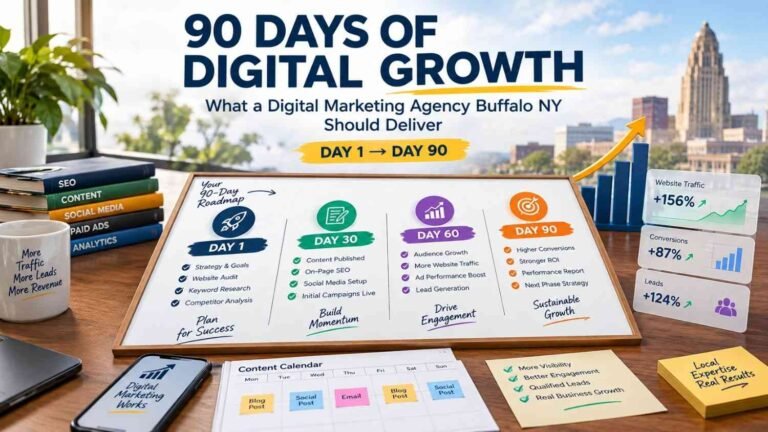


The blog discusses KPIs tracked by a Data-driven marketing agency in Buffalo. In the modern marketing era, guesswork is no longer the order of the day. Companies desire an increase in business, a quantifiable outcome, and a definite indication that its marketing expenditure is being utilized. That is why all data-driven marketing agencies Buffalo monitor key performance indicators (KPIs) to inform strategy and optimize campaigns. These performance metrics are becoming more important in the decision-making process of companies in Buffalo to attain sustainable growth.
In this article, the authors are going to discuss the most significant marketing KPIs, their importance, and the way in which agencies can apply them in order to achieve measurable success.
Why KPIs Matter in Digital Marketing
Marketing KPIs are quantifiable numbers that demonstrate the effectiveness of campaigns to meet business objectives. In the absence of KPIs, marketing is just a matter of opinion instead of being evidence-based.
Measuring performance measures assists agencies:
- Understand what’s working
- Find out improvement areas.
- Allocate budgets efficiently
- Forecast future growth
- Demonstrate a payback (ROI)
A data-driven strategy will make sure that all campaign choices are supported by actual information as opposed to speculation.
Traffic and Visibility KPIs
The awareness and reach stage is the initial phase of the marketing funnel. Agencies keep track of the number of people who learn about your brand and the way they do it.
Website Traffic
Website traffic determines the number of visitors to your site. Agencies analyze:
- Total visitors
- New vs returning users.
- Traffic sources (organic, paid, social, referral)
The initial indication of successful marketing activities is usually the growth in traffic.
Organic Search Rankings
Ranking on the search engine determines the visibility of your site on the search results. Agencies track:
- Keyword rankings
- Search impressions
- Search click-throughs
Better positioning results in superior traffic and sustainable development.
Impressions and Reach
In the case of paid advertisements and social media advertising, impressions refer to the frequency of content usage by the audience. Reach is the number of individual users who view your message.
These indicators assist the agencies in assessing brand exposure and campaign visibility.
Engagement KPIs
The traffic is not sufficient. Agencies also monitor the interactions of the users with your content.
Bounce Rate
The bounce rate is the proportion of visitors who visit a webpage and fail to act. A bounce rate can be high, and this may signify:
- Delays in the loading of pages.
- Poor user experience
- Irrelevant content
A decrease in bounce rate will enhance conversions and interaction.
Average Session Duration
This KPI is a measure of the amount of time users spend on your site. Sessions that are longer are an indication of good content and user interest.
Pages Per Session
This is a measure of the number of pages that the visitors navigate in a single visit. The more the better, as it indicates that users are researching your services.
Lead Generation KPIs
When the user uses your content, the second objective is to convert them to leads.
Conversion Rate
The conversion rate is a measure of the number of visitors who do something desired, e.g.
- Completing a form of contact.
- Subscribing to a newsletter.
- Requesting a quote
One of the most significant objectives of digital marketing is to increase the conversion rate.
Cost Per Lead (CPL)
CPL demonstrates the price per lead in the case of paid advertising. A smaller CPL indicates that the campaigns are more efficient.
Lead Quality
Leads are not all equal. Agencies evaluate:
- Lead intent
- Demographics
- Readiness to buy
Quality leads enhance sales success.
KPIs of Sales and Revenue
The ultimate measure of marketing success is an increase in revenue. The agencies monitor KPIs that relate to marketing activities to business outcomes.
Customer Acquisition Cost (CAC)
CAC is a measure of the cost of acquiring a new customer. It includes:
- Advertising spend
- Marketing tools
- Agency fees
Decreased CAC implies increased marketing efficiency.
Customer Lifetime Value (CLV)
CLV approximates the amount of revenue that a customer brings over a period of time. Marketing is profitable when the CLV exceeds CAC
Return on Ad Spend (ROAS).
ROAS measures revenue generated for every dollar spent on advertising. For example, a ROAS of 5:1 means every $1 spent generates $5 in revenue.
Social Media Marketing KPIs
Brand awareness and engagement require social platforms.
Engagement Rate
It is a measure of likes, comments, shares, and saves. A high engagement means that content appeals to audiences.
Follower Growth
The steady growth indicates growing brand recognition and community interest.
Click-Through Rate (CTR)
CTR is an indicator of the number of individuals who use the links on social media to visit your site.
Email Marketing KPIs
Email is still one of the marketing channels that has the highest ROI.
Open Rate
Open rate indicates the number of recipients who open emails. It indicates the effectiveness of subject lines and interest to the audience.
Click-Through Rate (Email)
This is a metric used to determine the number of readers who have clicked on links within emails.
Unsubscribe Rate
Unsubscribe tracking is used to detect content exhaustion or communication problems within agencies.
Content Marketing KPIs
Organic traffic and authority are motivated by content marketing.
Top Performing Pages
The agencies examine the pages that generate:
- The most traffic
- The most leads
- The most conversions
This assists in polishing the content strategy.
Backlinks
Backlinks refer to the links of other sites to yours. More quality backlinks enhance SEO authority and rankings.
Content Engagement
Metrics include:
- Shares
- Comments
- Scroll depth
- Time on page
These insights demonstrate what content is most resonant.
Local SEO KPIs
Local search metrics are vital in businesses that focus on local customers.
Google Business Profile Interactions
Agencies track:
- Calls
- Direction requests
- Website clicks
These measures demonstrate the interaction with the local customers with your business.
Local Search Rankings
Monitoring the ranking of location-based keywords assists businesses in conquering their local market.
Customer Retention KPIs
It is not just about gaining customers but retaining them as well.
Repeat Purchase Rate
This KPI will demonstrate the number of returning customers who make a second purchase.
Customer Retention Rate
Increased retention decreases marketing expenses and enhances profitability.
Customer reviews and satisfaction
Good reviews enhance trust and impress new clients.
How Agencies Use KPI Data to Improve Campaigns
Measuring KPIs is just the beginning. Agencies based on data make use of evidence to optimize campaigns continuously.
They:
- Adjust ad targeting
- Improve website UX
- Refine messaging
- Optimize landing pages
- Reallocate budgets
The result of this cycle of continuous improvement is improved results in the long-term.
The Importance of Customized KPI Dashboards
All businesses possess various objectives. An e-commerce store, a contractor, and a law firm will monitor various KPIs.
Data-driven agencies create customized dashboards that show:
- Real-time performance
- Monthly growth trends
- Campaign comparisons
- ROI metrics
Transparency in reporting keeps businesses in the know and reassured.
The role of KPI Tracking in enhancing business strategy in the long term
The greatest benefit of continuously measuring KPIs by a data-driven marketing agency is that it enhances long-term strategies. Companies in Buffalo are more and more requiring foreseeable expansion, and KPI dashboards can act as a guide towards sustainable execution.
Turning Data Into Smarter Decisions
KPIs make agencies shift towards a proactive strategy rather than reactive marketing. Teams do not have to wait months to review the results, but can do so weekly or even daily. This will enable them to:
- Early declining trends.
- Identify new opportunities quickly
- Experiment with new strategies.
- Make real-time adjustments to campaigns.
This loop of constant improvement will ensure that there is no budget wastage and that the campaign will be more effective.

Budget Allocation Based on Performance
In the absence of KPIs, marketing budgets tend to be based on assumptions. Using performance metrics, agencies can be able to clearly define the channels that yield the best returns.
For example:
- If SEO generates consistent leads at a low cost, the investment increases.
- If paid ads produce high-quality customers, scaling becomes easier.
- If a channel underperforms, budgets shift to higher-ROI strategies.
This ensures every marketing dollar works harder.
Forecasting and Predictive Marketing
Forecasting future growth is one of the greatest advantages of KPI tracking. Through a past performance analysis, agencies can forecast:
- Seasonal demand trends
- Lead volume projections
- Revenue growth potential
- Advertising budget requirements
This assists businesses with more confidence in planning their hiring, inventory, and expansion.
Cross-Channel Performance Integration
The current marketing is a combination of various platforms, including SEO, paid advertising, email, social media, and content marketing. KPIs will assist agencies in knowing the interaction between these channels.
For example:
- Social media can be a catalyst for awareness.
- SEO may generate research traffic
- Paid advertisements can turn leads into fast.
- Long-term customers can be cultivated through email marketing.
When the agencies tie these data points together, they end up with a picture of the entire customer journey.
Competitive Advantage Through Analytics
Companies that monitor performance measures consistently have a significant competitive edge. They:
- React quicker to market changes.
- Optimize campaigns continuously
- Improve customer experiences
- Make the company profitable in the long term.
Analytics turns marketing into an effective growth generator and not a game of chance.
Final Thoughts
Measurable performance is important in marketing. With data on traffic, engagement, leads, sales, and retention, data-driven agencies make marketing a predictable growth engine.
The companies that work on KPIs become clear, efficient, and have a competitive advantage. Having the right performance metrics, marketing no longer remains a guesswork, but a process of steady and quantifiable success.
FAQs
01 What are marketing KPIs?
Marketing KPIs are measurable values that show how effectively marketing campaigns achieve business goals such as traffic growth, lead generation, customer acquisition, and revenue improvement.
02 Why do businesses track marketing KPIs?
Tracking KPIs helps businesses understand what strategies work, optimize campaigns, reduce wasted spending, and make data-driven decisions that improve long-term growth and profitability.
03 How often should marketing KPIs be reviewed?
Most agencies review KPIs weekly and monthly. Frequent monitoring helps identify trends early and allows quick adjustments to improve performance and maximize marketing results.
04 What is the most important KPI in digital marketing?
There is no single most important KPI. The best metric depends on business goals, but conversion rate, customer acquisition cost, and return on investment are among the most critical indicators.
05 How do KPIs help small businesses grow?
KPIs provide clear insight into what marketing channels generate leads and sales, helping small businesses focus budgets on high-performing strategies and scale faster with less risk.
06 What is a KPI dashboard?
A KPI dashboard is a visual report that displays marketing performance metrics in real time, making it easier to monitor progress, track trends, and share results with stakeholders.
07 Do all businesses track the same KPIs?
No, KPIs vary depending on industry, target audience, and business objectives. A service company and an e-commerce store will track different performance metrics.
08 What is a conversion rate?
Conversion rate measures the percentage of visitors who complete a desired action, such as filling out a form, making a purchase, or scheduling a consultation.
09 What is customer acquisition cost (CAC)?
CAC measures how much money a business spends to gain a new customer, including advertising costs, marketing tools, and agency fees.
10 What is return on ad spend (ROAS)?
ROAS calculates how much revenue is generated for every dollar spent on advertising, helping businesses determine the effectiveness of paid marketing campaigns.
11 How do KPIs improve marketing budgets?
KPIs reveal which channels deliver the best results, allowing agencies to shift budgets toward high-performing strategies and reduce spending on underperforming campaigns.
12 Why are local marketing KPIs important?
Local KPIs track calls, direction requests, and listing clicks, helping businesses attract nearby customers and improve visibility in local searches in places like Buffalo.
13 What is customer lifetime value (CLV)?
CLV estimates the total revenue a customer generates throughout their relationship with a business, helping companies understand long-term profitability.
14 Can KPIs predict future growth?
Yes, by analyzing historical performance and trends, agencies can forecast future leads, revenue, and seasonal demand with greater accuracy.
15 Why hire a data-driven marketing agency?
A data-driven agency uses analytics and performance metrics to continuously optimize campaigns, ensuring marketing decisions are based on measurable results rather than guesswork.