
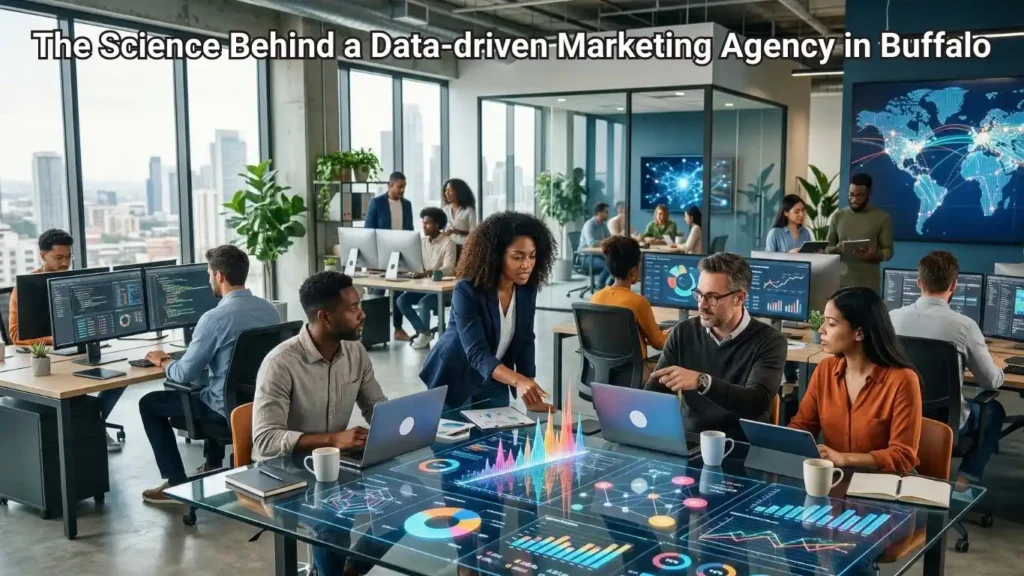
The following blog tells The Science Behind a Data-driven Marketing Agency in Buffalo. In the current marketing, it is no longer a matter of guesswork and intuition. Rather, effective campaigns are based on information, statistics, and quantifiable data to make decisions. This is the reason why a lot of businesses collaborate with a Data-driven marketing agency in Buffalo that employs scientific techniques to examine customer behavior and maximize the use of marketing strategies.
Data-driven marketing is based on marketing science, which is the combination of analytics, technology, and behavioral insights to comprehend the customer interaction with brands. With the help of such tools as attribution models, marketing specialists may identify channels and campaigns that give the most effective results.
Through this paper, we are going to examine the nature of the marketing science process and how a metric-driven approach can assist a business to attain greater, more quantifiable results.
What Does Data-Driven Marketing Mean?
Data-driven marketing. This is a model that employs the use of data analysis to inform marketing choices.
A Data-driven marketing agency in Buffalo not only acts on assumptions but also gathers and evaluates data from various sources, among them being:
- website analytics
- social media engagement
- advertising performance
- customer purchase history
- email marketing data
This knowledge assists marketers in knowing the strategies that perform better as well as areas where they can be improved.
The Marketing Science Role
Marketing science is the application of statistical analysis, data modeling, and research techniques to the study of the behavior of consumers and the optimization of marketing performance.
It combines elements of:
- data analytics
- consumer psychology
- machine learning
- predictive modeling
Through the application of scientific principles, marketers are able to come up with campaigns that are more focused and effective.
Companies that employ a Data-driven marketing agency in Buffalo enjoy the advantages of these high-level tools of analysis.
Why Data Matters in Modern Marketing
In the past few years, the marketing channels have increased tremendously.
Companies are advertising their products by:
- search engines
- social media platforms
- email campaigns
- online advertising
- content marketing
There are numerous channels to be used, and sometimes it is hard to say which of them leads to getting leads and revenue.
It is at this point that the attribution models come in.
Comprehending Attribution Models
Attribution models are schemes that determine the manner in which credit for conversions is attributed to various marketing touchpoints.
For example, a customer might:
- Find a company by searching on Google.
- Read a blog article.
- Visit a social media advertisement.
- Finally, make a purchase
Attribution models refer to the identification of which of these steps had the greatest contribution to the end outcome conversion.
One of the Data-driven marketing agency in Buffalo applies the attribution analysis to comprehend customer journey and use the marketing budgets most effectively.
Typical Attribution Model Forms
Digital marketing usually involves a number of attribution models.
First-Touch Attribution
This model fully recognizes the initial encounter that a customer has with a brand.
It assists businesses to learn how new customers get to know their products or services.
Last-Touch Attribution
Last-touch attribution gives credit to any interaction that happens before a conversion.
This model is simplistic and can ignore the previous impacts of the customer journey.
Multi-Touch Attribution
Multi-touch attribution spreads credit in various interactions.
This method gives a better idea of a combination of marketing channels.
Most of the Data-driven marketing agency in Buffalo tend to use this model due to the fact that it provides more in-depth information on the performance of the campaign.
Data Collection in Marketing
Effective marketing by means of data depends on gathering pertinent and dependable information.
Common data sources include:
- website analytics tools.
- advertising dashboards
- CRM systems
- social media insights
- customer surveys
Such points will assist marketers in studying customer behavior and pointing out trends.
These insights are converted into practical approaches through the use of marketing science.
Predictive Analytics in Marketing
The other weapon that comprises Data-oriented marketing teams is predictive analytics.
It is the process of evaluating past records in order to know what will happen in the future.
Examples are predictions of:
- buying behavior of the customers.
- seasonal demand patterns
- advertising performance
- lead conversion rates
Predictive analytics can help a Data-driven marketing agency in Buffalo to plan campaigns better and cut down on wasted marketing dollars.
Data-driven Customer Segmentation
Customers do not all act in the same manner.
The analysis of data enables a marketer to segment audiences into certain groups according to their attributes, such as:
- demographics
- purchasing behavior
- interests
- online activity
This is referred to as segmentation.
Marketers can use the personalized approach to reach these groups and increase engagement and conversion.
A/B Testing and Experimentation
Scientific marketing is commonly used where various versions of the campaigns are tested in order to present the one that is best.
This is referred to as A/B testing.
As an example, marketers can test:
- dissimilar headlines in commercials.
- alternative email messages.
- landing page designs variations.
- different calls to action
The experiments enable businesses to hone their strategies based on actual data, rather than assumptions.
Marketing Performance Measurement
Measurement is a major tenet of marketing science.
The key performance indicators (KPIs) monitored by marketers include:
- website traffic
- click-through rates
- conversion rates
- cost per acquisition
- return on investment (ROI)
These measurements are applied by a Data-driven marketing company in Buffalo to create ever-enhancing marketing campaigns.

Technology Used in Data-Driven Marketing
The modern type of marketing is based on highly developed technology platforms, which are able to gather and process vast amounts of data.
The tools that are frequently used are:
- analytics platforms
- marketing robots.
- customer relationship management system.
- management tools in advertising.
- data visualization dashboard.
Such technologies enable marketers to conduct complex data analysis and extract valuable insights.
Benefits of Working With a Data-Driven Marketing Agency
Companies that collaborate with a data-driven marketing company in Buffalo benefit in a number of ways.
Better Marketing Effectiveness.
The analysis of data assists in determining which campaigns yield the most results.
Better Budget Allocation
The knowledge about attribution models enables each company to invest in the most effective channels.
Higher Conversion Rates
Data campaigns reach the correct audience with personalized messages.
Measurable Results
Businesses have the opportunity of measuring performance and revise strategies by using actual data.
Challenges in Data-Driven Marketing
Despite the numerous advantages of data-driven marketing, there are some difficulties as well.
The following are some of the typical barriers:
- managing large datasets
- ensuring data accuracy
- combining different marketing platforms.
- understanding complicated analytics reports.
Marketing experts use marketing science to get beyond these hurdles and find useful information.
The Future of Marketing Science
The place of the data in marketing will keep developing with emerging technology.
Emerging trends include:
- Marketing analytics artificial intelligence.
- real-time personalization.
- high-order predictive modelling.
- auto campaign optimization.
Companies that embrace the technologies in their early stages will attain an edge.
One of the marketing agencies in Buffalo is data-based, which means that it assists businesses to be ahead of the pack by enforcing the most recent innovations in the science of marketing.
Final Thoughts
The modern marketing landscape is driven by data, analytics, and measurable insights. Businesses that rely on guesswork often struggle to compete in today’s digital environment.
Through the principles of marketing science, companies can analyze customer behavior, optimize campaigns, and improve return on investment. Tools such as attribution models provide valuable insight into how different marketing channels contribute to conversions.
By partnering with a Data-driven marketing agency in Buffalo, businesses gain access to advanced analytics, strategic expertise, and technology-driven solutions that transform data into measurable growth.
FAQs
01 What is marketing science?
Marketing science uses data analysis, statistics, and research methods to improve marketing performance and understand consumer behavior.
02 What are attribution models?
Attribution models are frameworks used to determine how different marketing channels contribute to conversions.
03 Why is data-driven marketing important?
Data-driven marketing helps businesses make informed decisions, improve campaign performance, and maximize return on investment.
04 What does a data-driven marketing agency do?
A Data-driven marketing agency in Buffalo analyzes marketing data, develops targeted campaigns, and measures results to improve performance.
05 How long does it take to see results from data-driven marketing?
Results vary depending on the strategy, but businesses typically begin seeing improvements within a few months as campaigns are optimized.