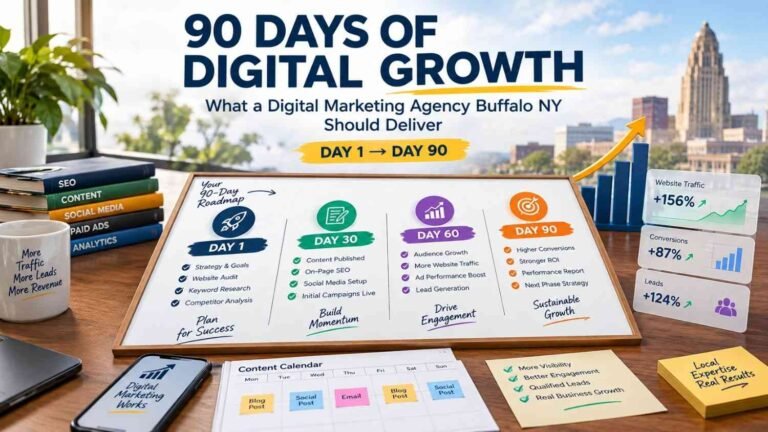


The blog tells about Website Optimization Tips From a Digital Marketing Agency in Buffalo, NY. In today’s competitive digital world, simply having a website isn’t enough. Companies should have a website isn’t enough. Companies should have websites that turn visitors into customers. That’s where Website CRO (Conversion Rate Optimization) and UX optimization become essential. A high-performing website doesn’t happen by accident; it’s carefully designed, tested, and continuously improved.
This guide will discuss the best website optimization tips that a digital marketing agency in Buffalo, NY has applied to assist firms in growing their traffic, user experience, and conversions.
Why Website Optimization Matters More Than Ever
Potential customers might be having the first impression of your business through your website. Unless visitors can quickly locate what they require or have to put up with slow loading speed, they are going to go away- and probably go to a competitor.
Website optimization can assist you:
- Increase conversions and sales
- Improve search engine rankings
- Enhance user satisfaction
- Reduce bounce rates
- Maximize ROI on marketing campaigns.
Even small improvements can lead to major growth in leads and revenue.
Understanding Website CRO (Conversion Rate Optimization)
Website CRO is concerned with converting visitors to paying customers. CRO makes sure that your traffic is more effective rather than simply increasing it.
Examples of conversions are:
- Making a purchase
- Completing a contact form.
- Booking an appointment
- Recent subscriptions to a newsletter.
A website that attracts traffic but fails to convert visitors wastes valuable marketing opportunities.
Start With Speed Optimization
Why Speed Matters
One of the key ranking and conversion factors is the speed of the websites. Research indicates that websites that take more than 3 seconds to load are abandoned.
How to Improve Speed
- Reduce the size of pictures and videos.
- Apply for quick web hosting.
- Enable browser caching
- Minimize unnecessary plugins
- Optimize code and scripts
Websites that are faster enhance SEO and user experience.
Design for Mobile First
Mobile devices have become the source of more than half of web traffic. A mobile-friendly site is not an option anymore, but a necessity.
Mobile Optimization Tips
- Use responsive design
- Make sure that buttons are simple to tap
- Enlarge the text without enlarging
- Simplify navigation menus
- Make images smaller.
Mobile-first design will enhance rankings and retain visitors longer.
Improve Navigation and Site Structure
Visitors must be capable of locating information easily and swiftly. Lost customers and frustration due to confusion in navigation.
Best Practices
- Make menus uncomplicated and straightforward.
- Limit top-level navigation items
- Add a search bar
- Apply well-defined page categories.
- Include breadcrumb navigation
A well-structured design enhances usability and search engine optimization.
Optimize your Homepage for Conversions
Your home page must say at a glance:
- Who you are
- What you offer
- Why customers should choose you
High-Converting Homepage Elements
- Powerful headline and value proposition.
- Obvious call-to-action (CTA) buttons.
- Social evidence and testaments.
- Professional visuals
- Easy navigation
The next step should be taken on your homepage
Create Clear and Compelling Calls-to-Action
CTAs inform visitors of their next steps. In the absence of effective CTAs, users can abandon their sites.
Effective CTA Tips:
- Talk in action words (Get Started, Book Now)
- Visually make buttons prominent.
- Insert CTAs on pages.
- Minimize the conversion process.
Even minor CTA modifications have the potential to drive a lot of conversions.
Use Social Proof to Build Trust
An important aspect of online decision-making is trust.
Types of Social Proof
- Customer reviews
- Testimonials
- Case studies
- Client logos
- Industry certifications
The presentation of real-life experiences will assure the potential customers and minimize reluctance.
Improve Content Readability
Tourists do not read all words; they skim. Your material should be readily digestible.
Readability Tips
- Use short paragraphs
- Insert bullet points and headings.
- Highlight key information
- Use simple language
- Insert pictures and symbols.
Coherent information retains users and drives them to action.
Optimize Landing Pages for Campaigns
Landing pages are supposed to be single-purpose and eliminate distractions.
Elements that are high-converting landing pages.
- Single-focused message
- Powerful headline and subheadline.
- Benefit-driven content
- Clear CTA
- Minimal navigation
Specific landing pages can convert significantly higher than general web pages.
Leverage A/B Testing for Continuous Improvement
Optimization of websites is a continuous process. AB testing can be used to determine what works best.
Elements to Test:
- Headlines
- CTA buttons
- Images and videos
- Page layouts
- Pricing displays
Testing eliminates guessing and assists in making decisions based on data.
Reduce Bounce Rate With Better UX Optimization
Bounce rate is the measure of how fast visitors are leaving your site. High bounce rates are largely due to poor user experience.
UX Optimization Strategies:
- Quicken the page loading time
- Use engaging visuals
- Simplify navigation
- Provide clear messaging
- Ensure mobile responsiveness
Improved UX will retain users on your site and boost conversions.
Optimize Forms for Higher Conversions
Long or complicated forms discourage users from completing them.
Form Optimization Tips
- Only ask necessary questions
- Autofill and drop-downs
- Show progress indicators
- Include trust signals around forms
- Instantly confirm messages
Form simplification can lead to a substantial increase in lead generation.
Focus on SEO and CRO Together
SEO will attract visitors to your site, and CRO will turn them into customers. The two strategies should collaborate to achieve their best.
Important SEO + CRO Strategies.
- Optimize content and keywords.
- Enhance page speed and mobile usability
- Use structured data
- Create valuable blog content
- Optimize internal linking
Combining SEO and CRO ensures consistent growth.
Track Performance With Analytics
Information helps determine what is performing well and what needs improvement.
Key Metrics to track.
- Conversion rate
- Bounce rate
- Average session duration
- Traffic sources
- Click-through rates
Continuous optimization and growth are guaranteed through regular analysis.
The Importance of Professional Website Audits
Hidden problems that impair performance are revealed through a professional audit of websites.
What an Audit has:
- Technical SEO analysis
- Speed testing
- UX evaluation
- Conversion funnel analysis
- Competitor benchmarking
A detailed audit is a blueprint for improvements.
The Role of Visual Hierarchy in Website CRO
Visual hierarchy is the manner in which the elements are placed in order to direct the attention of the visitors to the most crucial aspects of a page. Once the users get to a web page, they automatically scan through it within a few seconds. Unless key information is easily perceived, they might walk away without doing anything.
How to Build Strong Visual Hierarchy
An optimized page is designed in a way to make visitors follow the content of the page in a natural way using size, color, spacing, and placement.
Best practices include:
- Headlines of key messages are large.
- Call-to-action buttons are contrasting in color.
- Blank areas to divide key areas.
- Bright color pictures that reinforce text.
Once visual hierarchy is applied appropriately, visitors will get your message quicker and will be more assured to move on.
The Importance of Above-the-Fold Content
The part of a web page that is not seen as the result of scrolling is called above the fold. This section identifies the stays or visits of visitors.
What to Include Above the Fold
The most significant information that you need must be at the top, and it includes:
- Clear value proposition
- Strong headline
- Supporting subheading
- Primary call-to-action
- Trust signals or testimonials
The visitors must immediately understand what your business is all about and how to get started.
Improving User Engagement With Interactive Elements
Websites are more entertaining and memorable through the use of interactive elements. They promote visitors to spend a longer time on your site and engage with your content.
Interactive Features: examples.
- Live chat support or chatbots.
- Interactive calculators or quizzes
- Hover effects and animations
- Demos or explainers of products
These features enhance engagement and convert better when applied in a strategic way.
The Power of Personalization
Contemporary customers desire customized services. Conversations can be greatly enhanced by adjusting the content of the websites to the behavior of the visitors.
Personalization Strategies:
- Display location-based offers
- Suggest products according to the history
- Target recurrent visitors
- Display dynamic headlines based on user interests.
Individual experiences enable the visitor to feel comprehended and cherished.
Building Trust Through Transparency
Trust is paramount in conversion decisions. Tourists should be assured to give out information or to make purchases.
How to establish trust online.
- Post contact details on the page.
- Add security badges and privacy policies.
- Offer transparent pricing and money-back policies.
- Present actual customer reviews.
- Add team pictures and company profile.
Transparency reduces hesitation and increases credibility.
Optimizing Product and Service Pages
Service and product pages are commonly the most crucial conversion pages of a site.
Critical Components of Converting Pages.
- Benefit-focused headlines
- High-quality images or videos
- Clear pricing or packages
- Customer reviews and testimonials
- FAQ sections addressing concerns
Optimized pages provide answers to questions even before the customers ask them.
The Impact of Internal Linking
Internal links take visitors to other content and assist search engines in knowing how your site is structured.
Internal Linking Benefits:
- Improves SEO rankings
- Promotes casual browsers to visit additional pages.
- Reduces bounce rate
- Strengthens content authority
Internal linking is strategic and helps users remain involved and enhance search visibility.
Using Heatmaps and User Behavior Tracking
Knowledge of the interaction of visitors with your site will guide you on areas to improve.
Tools and Insights
Heatmaps show:
- Most frequently clicked areas by the users
- Distance travelled by visitors
- What are the aspects of interest?
- Where users are lost
Such insights enable companies to make informed enhancements rather than speculate.
Reducing Friction in the Customer Journey
Friction is anything that causes visitors to have difficulties in taking action.
Common Friction Points
- Slow loading pages
- Complicated checkout processes
- Too many form fields
- Confusing navigation
- Signs of mistrust
Eliminating friction simplifies the conversion process for the user and enhances overall satisfaction.
The Importance of Consistent Branding
Your consistency throughout your site enhances more recognition and trust.
Branding Best Practices
- Make use of similar colors and fonts.
- Be consistent in tone of voice.
- Make sure of the similarity in the style of imagery.
- Coordinate the website design and marketing materials.
An integrated brand experience creates trust and expertise.
Optimizing Checkout and Payment Processes
In the case of e-commerce sites, it is essential to optimize checkout.
How to increase the Conversion on Checkout.
- Provide guest check-out
- Offer a variety of payments
- Show shipping prices early
- Use progress indicators
- Simplify checkout forms
An easy checkout process minimizes cart abandonment.
Leveraging Video Content for Higher Engagement
One of the most effective tools to boost conversions is video.
Categories of Videos to include:
- Explainer videos
- Product demonstrations
- Customer testimonials
- Behind-the-scenes content
Videos can be used to convey information in a short time and create an emotional attachment with visitors.

The Importance of Ongoing Website Maintenance
The optimization of websites is not a project. Constant monitoring and updates are needed.
Regular Maintenance Tasks
- Plugging in and updating software.
- Fixing broken links
- Monitoring site speed
- Refreshing content
- Reviewing analytics data
Frequent upkeep will help in maintaining your website as fast, secure, and efficient.
Aligning Website Optimization With Marketing Campaigns
All marketing efforts should be supported on your site, including:
- Social media campaigns
- Email marketing
- Paid advertising
- SEO strategies
The alignment of campaigns and landing pages enhances user experience and increases the number of conversions.
Turning Website Visitors Into Loyal Customers
The end game of the optimization of the website is not only conversions, but long-term customer relations.
Strategies for Retention
- Provide good blog content
- Provide helpful resources and guides
- Keep in touch via email marketing
- Promote repetition of visits through specials
An optimized site will be a long-term growth engine for your business.
Climate-Specific Roofing Solutions for Buffalo Homes
Roofing strategies in Buffalo must be tailored to regional weather patterns. Unlike warmer climates, roofs here face prolonged snow coverage, freezing rain, and extreme temperature swings. Professional roofing companies design systems specifically engineered to withstand these challenges.
Snow Load Considerations
Snow accumulation adds significant weight to roofs during winter. Experienced roofers calculate load capacity and ensure proper structural support. Reinforced decking and high-performance shingles help prevent sagging or structural stress.
Freeze–Thaw Resistance
Frequent temperature changes cause ice to melt and refreeze repeatedly. This process can expand tiny cracks into major leaks. Durable roofing materials and sealants are selected specifically to resist this damaging cycle.
The Importance of Roof Deck Protection
Beneath shingles lies the roof deck, which acts as the structural base of the roofing system. If this layer becomes compromised, the entire roof is at risk.
High-Performance Decking Materials
Professional roofers inspect decking carefully and replace weakened areas before installation. Strong plywood or oriented strand board (OSB) is commonly used for durability and moisture resistance.
Moisture Barriers
Advanced moisture barriers are installed over the decking to prevent water infiltration. These protective layers act as the last line of defense if shingles become damaged during storms.
Gutter Systems and Roof Longevity
A durable roof works hand in hand with a well-designed gutter system. Without proper drainage, water can accumulate and damage roofing materials.
Seamless Gutters
Professional roofing companies often install seamless gutters that reduce leaks and improve water flow.
Downspout Placement
Strategic downspout placement ensures water is directed away from the home’s foundation and roofing edges, preventing erosion and ice buildup.
Gutter Guards
Gutter guards reduce debris buildup and help maintain consistent water flow, especially during fall and winter.
Advanced Roofing Technology and Innovations
Modern roofing technology has significantly improved durability and performance.
Impact-Resistant Shingles
These shingles are engineered to withstand hail and debris impact. They offer enhanced protection during severe storms and reduce the likelihood of costly repairs.
Reflective Roofing Materials
Reflective shingles help regulate roof temperature by reflecting sunlight. This reduces heat absorption and improves energy efficiency.
Synthetic Underlayment
Synthetic materials are stronger and more water-resistant than traditional felt underlayment, providing an extra layer of protection.
Professional Roof Replacement Planning
When a roof reaches the end of its lifespan, replacement becomes necessary. Professional roofing companies follow a structured process to ensure long-term success.
Removal of Old Materials
Old shingles and damaged components are completely removed to expose the roof deck. This allows roofers to identify hidden damage before installing new materials.
Structural Reinforcement
Any weak or damaged areas are repaired to ensure the new roofing system has a strong foundation.
Precise Installation Process
New materials are installed using industry best practices and manufacturer guidelines to maximize durability.
Seasonal Roof Care Tips for Homeowners
Homeowners play an important role in maintaining roof longevity between professional inspections.
Spring Maintenance
After winter, check for:
- Missing or damaged shingles
- Gutter blockages
- Signs of water damage
Early detection prevents small issues from worsening.
Summer Maintenance
Warm weather is ideal for:
- Scheduling inspections
- Cleaning debris from roof surfaces
- Checking attic ventilation
Fall Preparation
Before winter:
- Clear gutters and downspouts
- Inspect flashing and seals
- Trim overhanging tree branches
Preparing your roof for winter reduces the risk of snow and ice damage.
Roof Safety and Professional Expertise
Roofing work involves significant safety risks. Professional roofing teams follow strict safety protocols to protect both workers and homeowners.
Safety Equipment and Training
Professional roofers use:
- Harnesses and fall protection
- Safety helmets and footwear
- Specialized roofing tools
Insurance and Liability Protection
Reputable roofing companies carry insurance to protect homeowners from liability in case of accidents. This provides peace of mind throughout the project.
Signs Your Roof Needs Professional Attention
Recognizing early warning signs can prevent costly repairs.
Interior Warning Signs
- Water stains on ceilings or walls
- Mold or mildew growth
- Increased energy bills
Exterior Warning Signs
- Curling or cracked shingles
- Sagging roof areas
- Granules in gutters
If any of these signs appear, professional inspection is essential.
How Roof Color and Design Impact Durability
Roof color and style influence performance as well as aesthetics.
Dark vs. Light Shingles
Dark shingles absorb heat and help melt snow faster, reducing ice dam risk. Light shingles reflect heat and improve energy efficiency during summer.
Architectural Shingles
Architectural shingles are thicker and more durable than traditional three-tab shingles. They provide better wind resistance and longer lifespan.
The Role of Professional Project Management
Roofing projects require careful planning and coordination.
Scheduling and Material Delivery
Professional companies ensure materials arrive on time and projects stay on schedule.
Quality Control Inspections
Multiple inspections during installation guarantee that every component meets quality standards.
Final Walkthrough and Cleanup
After installation, roofers conduct a final inspection and thoroughly clean the property.
Environmental Benefits of Durable Roofing
Durable roofing systems contribute to environmental sustainability.
Reduced Waste
Long-lasting roofs reduce the need for frequent replacements, minimizing landfill waste.
Energy Efficiency
Energy-efficient roofing reduces heating and cooling demands, lowering overall energy consumption.
Recyclable Materials
Many roofing materials can be recycled at the end of their lifespan.
Choosing the Right Roofing Partner
Selecting a professional roofing company is one of the most important decisions homeowners make.
What to Look For
- Local experience and reputation
- Proper licensing and insurance
- Transparent pricing
- Strong warranties
- Positive customer reviews
Working with experienced professionals ensures long-term results and reliable service.
Long-Term Peace of Mind
A durable roof provides more than protection—it provides peace of mind. Homeowners can feel confident knowing their property is safeguarded against harsh weather, costly repairs, and unexpected damage.
By investing in expert roofing services, high-quality materials, and ongoing maintenance, homeowners can enjoy decades of reliable performance and long-term value.
This expanded section further strengthens the article by highlighting advanced techniques, homeowner responsibilities, and long-term durability strategies.
Final Thoughts
Website optimization is not a singular activity but a continuous process, and it should be tested, analyzed, and polished. With the help of the Website CRO, UX optimization, and performance enhancements, the businesses can convert their websites into potent lead-generation and sales instruments.
By collaborating with a Digital marketing agency in Buffalo, NY, you can be sure that your website remains competitive, easy to use, and can be further expanded.
FAQs
01 What is Website CRO and why is it important?
Website CRO focuses on improving your site so more visitors take action, such as making purchases or filling out forms. It helps businesses increase revenue without needing to increase traffic.
02 How does UX optimization affect conversions?
UX optimization improves how users interact with your website. When navigation is easy, pages load quickly, and information is clear, visitors stay longer and are more likely to become customers.
03 How often should a website be optimized?
Website optimization should be ongoing. Regular updates, testing, and performance reviews help ensure your website stays competitive, user-friendly, and aligned with changing customer behavior and search engine requirements.
04 Why is website speed important for conversions?
Slow websites frustrate users and increase bounce rates. Faster loading times improve user satisfaction, search rankings, and conversion rates because visitors are more likely to stay and explore your content.
05 What role does mobile optimization play in CRO?
Mobile optimization ensures your site works smoothly on smartphones and tablets. Since most users browse on mobile devices, a responsive design is essential for engagement, usability, and higher conversion rates.
06 How can A/B testing improve website performance?
A/B testing compares different versions of pages or elements to see what performs best. This data-driven approach helps businesses make informed decisions that improve conversions and user experience.
07 What are common signs a website needs optimization?
High bounce rates, low conversion rates, slow loading speed, outdated design, and poor mobile usability are strong indicators that your website needs professional optimization and performance improvements.
08 How does content affect website conversions?
Clear, engaging content helps visitors understand your value quickly. Well-structured text, strong headlines, and helpful information build trust and guide users toward taking action.
09 Can website optimization help SEO rankings?
Yes. Faster loading speeds, mobile responsiveness, improved navigation, and better user engagement all contribute to stronger search engine rankings and increased organic traffic.
10 Why should businesses hire a professional digital marketing agency?
A professional agency provides expertise, advanced tools, and data-driven strategies. They identify issues, implement improvements, and continuously optimize websites to deliver long-term growth and better return on investment.