
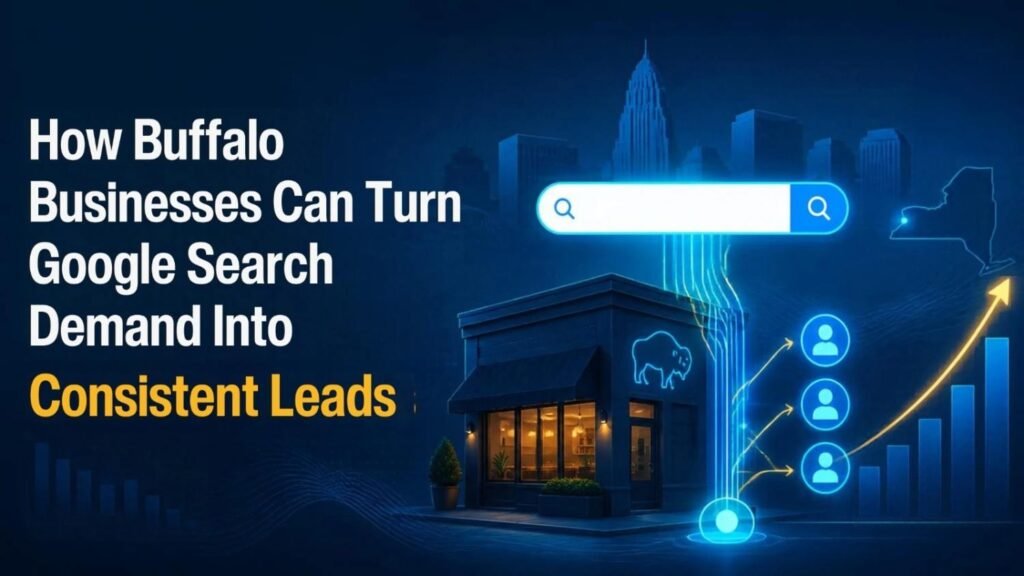
In today’s digital age, businesses must capitalize on the potential of Google search to generate leads, and the subject of How Buffalo Businesses Can Turn Google Search Demand Into Consistent Leads is no exception. In Buffalo, NY, people utilize Google for a number of reasons: to discover local services, to compare providers, to read reviews, and to determine which business to call. But being listed on search engines doesn’t necessarily mean you’re getting inquiries or sales. A clear strategy ties search visibility to useful website content, powerful landing pages, and easy conversion of visitors to leads.
When working with a digital marketing agency Buffalo NY companies can turn these activities into results. Rather than just website traffic and keywords, businesses can create a strategy around their customers, their search intent and quantifiable enquiries. The aim is to draw in those who are seeking a product or service and allow them to easily move to the next step.
Understanding What Google Search Demand Means for Local Businesses
Google search demand is the search demand of people for information, products and services. These searches can be useful to local businesses to find out what a potential customer may need and when they might be ready to reach out to a provider.
For instance, if a homeowner in Buffalo needs an emergency plumbing service, they have a different urgency as compared with someone who is looking into common plumbing issues. A business that grasps the difference can build more pertinent pages and calls of action for each audience.
There are generally three types of search demand.
| Search type | Example | Potential opportunity |
|---|---|---|
| Informational | How often should a roof be inspected? | Educate visitors and introduce relevant services |
| Commercial research | Best roofing companies in Buffalo | Help potential customers compare services and build trust |
| Transactional or service-focused | Roof repair company Buffalo NY | Encourage enquiries from people looking for a provider |
| Urgent local search | Emergency tree removal near me | Make contact details and service availability easy to find |
The following categories are helpful as starting points, but can overlap in search intent. Now one person researching a service might ultimately come to be a client later, while another visitor might be prepared to go out for a quote right away.
It is important that businesses do not assume that all their website visitors are the same either. The purpose and the next step should be consistent with the searcher’s intent.
Find the Search Terms That Can Generate Real Enquiries
It is more beneficial to find out what potential customers are looking for rather than just the high volume of keywords.
The advantage of a broad keyword is that it has the potential of drawing in a lot of visitors but few enquiries. A more specific search could result in less traffic, but traffic that is much closer to purchasing your product.
Focus on Service-Based Keywords
Local businesses need to be aware of what services they offer and the words that their customers might use to search for them. A Buffalo roofing company, for instance, may investigate queries for roof repair, roof replacement, storm damage, and roof inspections.
One important thing to keep in mind with a digital marketing strategy is people’s various ways of describing the same problem. Some customers look for services by name, and others are looking for a symptom or need.
Good keywords to research can be:
- What service is the customer looking for?
- Is the person researching a problem or ready to hire someone?
- Does the search indicate a local need?
- What questions might prevent the customer from making a decision?
- Which page should appear for this search?
Research Local Search Intent
Including a location with a keyword may help to establish local intent, but not all good local searches contain a city name. Phrases like “near me,” neighborhood names or terms such as service can be used in the search.
Content should be created that is truly relevant to the business’s geographical footprint. The number of nearly identical city pages published by a company should not be too great, and the only difference should be the city name. Useful local information should be provided on each page, and there must be a reason for each page existing.
Prioritize Keywords by Business Value
Search volume is not the only factor to take into account for keyword selection. Relevance, competition, customer intent, conversion potential, and the business serving the searcher are all important.
| Keyword opportunity | Priority consideration | Recommended action |
|---|---|---|
| Core service keyword | Closely matches a main revenue-generating service | Build or improve a dedicated service page |
| Urgent service keyword | Indicates an immediate need | Make phone and enquiry options easy to access |
| Comparison keyword | Suggests the customer is evaluating providers | Publish a useful comparison or decision guide |
| Question-based keyword | Reveals uncertainty or a common problem | Create a helpful article with a relevant next step |
| Location-based keyword | Indicates a geographic preference | Improve local relevance and service-area information |
A Digital Marketing Agency Buffalo NY businesses work with should link keyword research to profit-generating services. This will help to avoid situations where marketing becomes chasing the traffic that doesn’t have any commercial value attached.
Build Landing Pages Around Customer Needs
After identifying the relevant searches, companies must have landing pages that answer the searcher’s query and explain their next move.
A landing page is a page that is created to help achieve a specific objective, such as getting a quote, making an appointment, or making a phone call to a business. This doesn’t always have to be an additional advertising page. This can also be done with a well-structured service page.
Match the Page to the Search
If someone is looking for roof replacement, they should land on a page that explains that instead of a general home page that gives all the services the company provides.
The best service pages describe:
- What the service includes.
- Which problems it can address.
- Who the service is suitable for.
- What the process involves.
- What factors may affect the cost.
- Which locations the business serves.
- How to request more information or an estimate.
The page should respond to the customer’s probable inquiries and should not make the customer have to go through unrelated content.
Use Clear Calls to Action
A call-to-action is what you want your visitors to do next. This can be anything from requesting a quote, making a phone call to the office, scheduling a consultation or filling out a contact form.
This will vary depending on the service. Someone who has an emergency problem may prefer to call, and a person who’s assessing a contractor might prefer to fill out a contractor estimate online.
Avoid filling every section with competing buttons. One primary action, supported by a secondary option when useful, can make the page easier to understand.
Reduce Unnecessary Form Fields
Lots of paperwork can turn your visitors off if they just want to ask a simple question. Gather information necessary to effectively respond without asking for unnecessary information.
For instance, if there is a service enquiry, a name, contact method, service required, and brief description of the problem may be required. More information may be obtained in the subsequent conversation.
Use a mobile device for testing as well as a desktop computer. Fields should be easily completed, and visitors should get clear confirmation once they have completed an enquiry.
Turn Local Google Visibility Into Qualified Leads
Local visibility is helpful for businesses to connect with people looking for local services. Google Business Profile plays a crucial role in this process, particularly for eligible businesses.
A full profile can provide potential customers with information about the business, its location, and its contact information. But having a profile doesn’t mean you will rank high or get a steady stream of leads.

Keep Business Information Accurate
Verify contact information such as the business name, phone number, web address, hours of operation, and address or service area information. Changes need to be made as quickly as possible to ensure that customers are not using incorrect information.
Businesses that serve customers at their locations and businesses that travel to customers have different profile requirements. Service-area businesses should follow Google’s current eligibility and representation guidelines rather than displaying an address where customers are not actually served.
Choose Relevant Categories and Services
The primary business category should be as accurate as possible and describe the main activity of the business. Other categories and listed services should be as accurate as possible to what the company actually offers.
Don’t add unrelated services or use keywords in business names. Proper information enables customers to grasp what’s being offered and promotes a more reliable local presence.
Collect and Respond to Reviews
Customer reviews can affect customers’ perception of a business before interacting with them. With a little bit of effort, businesses can implement guidelines to encourage real customers to leave honest reviews, as long as they adhere to Google’s guidelines.
Be professional in both positive and negative reviews. Responses must maintain the confidentiality of customers and aim to address customer issues, not fight them out in public.
Review management should be integral to the overall customer experience process. Quality of service and effective communication are more important than just trying to get more of them.
Use Content to Capture Demand at Different Stages
After the initial search, not all prospective customers will be ready to reach out to a business. Some have to know a problem and compare solutions, know what influences pricing, etc., before making a decision.
Useful information can answer these queries and lead the visitor to the appropriate service page.
Create Problem-Solving Articles
A Buffalo company can write articles that answer your inquiries relating to their solutions. A roofing company may provide information on what to look for when inspecting a roof, and an accounting company may provide information on what records a small business should have ready for tax season.
It should be useful, rather than the article being filled with the same words over and over again. It should also lead the reader to a related service if that is the next logical step in the process for a reader.
Build Topic Clusters
A topic cluster is a group of articles that relates to a main service article, covering related questions and decisions.
For example, A home improvement company may structure content on roof repair, roof inspection, storm damage, roof replacement, roof materials, and the like. Every article should have a specific search goal and connect with other pages that the reader can be interested in reading more about.
This can help visitors to go through a topic without having to go through the same page for the same search term.
Refresh Content That No Longer Meets Search Intent
Older articles can drive impressions and few clicks or they can drive traffic that isn’t qualified. Check the content for the title, the structure of the page, the examples provided, and the next steps to ensure that all of them remain aligned with the search intent.
Avoid changing the publish date of a page without making any other changes. Add meaning and content, fix outdated information, answer missing questions, make it easier to read, and make it easier to link to a more relevant service page.
Improve Website Conversion Rates Before Chasing More Traffic
Many visitors to a website don’t generate a large number of leads. To attract more traffic, businesses need to make sure that their current pages allow people to easily get in touch with them.
Make Contact Options Visible
Make the key contact or phone number obvious for visitors. On mobile devices, there should be phone links that are clickable, and there should be clearly labelled enquiry buttons that you can click on to reduce friction.
When it comes to service businesses, visitors shouldn’t have to wade through multiple pages to find out how to get assistance.
Improve Mobile Usability
A lot of people search locally on their mobiles. Pages need to load without hassle, text needs to be easy to read without zooming, and buttons need to be easy to press.
Test that contact forms are working, navigation menus are easily accessible, and key information isn’t missing on a smaller screen.
Check Page Speed and Technical Issues
Slow pages, broken forms and confusing navigation can cause visitors to lose interest and not become leads. Use Google PageSpeed Insights to review performance, and test key pages from both desktop and mobile.
Technical enhancements might involve optimizing large images, removing superfluous scripts, repairing broken links, and correcting forms. Focus on usability and pages most critical to the business.
Use Paid Search to Capture Immediate Demand
While you can create visibility over time with search engine optimization, it may take longer for new or improved pages to start to show up. Another way to reach people who are looking for your services is paid search advertising.
Google Ads can be helpful when a business wants to try to understand demand for a service, advertise a seasonal offer, or promote high-priority services.
Start With a Defined Service and Goal
Don’t advertise all services at once start with a clear objective. For a business, it could be a quote request for a service or for a specific service for a specific customer.
There should be a landing page for each campaign, a geographic target for each campaign, and an action to convert for each campaign.
Use Negative Keywords
Negative keywords can help minimise unwanted ad impressions and clicks. If, for instance, the company provides a professional service, they may choose to exclude searches for free templates, employment opportunities or other do-it-yourself information.
Continue to check on search term reports and tune targeting to results.
Measure the Metrics That Connect Search to Revenue
Marketing performance can be more effective when businesses link marketing data to real customer enquiries and to sales results.
While rankings and web traffic can be useful indicators, they don’t tell the full business story.
| Metric | What it helps explain | How to use it |
|---|---|---|
| Search impressions | How often pages appear in Google results | Identify pages gaining or losing visibility |
| Organic clicks | How many people visit from unpaid search results | Compare traffic trends and page performance |
| Click-through rate | How often an impression leads to a click | Review titles, snippets, relevance, and search intent |
| Landing-page conversion rate | The proportion of visitors completing a desired action | Identify pages that need clearer messaging or easier forms |
| Number of leads | How many enquiries marketing generates | Compare performance across pages and channels |
| Qualified lead rate | How many enquiries match the business’s target customers | Assess whether traffic is relevant |
| Cost per lead | Marketing spend divided by the leads attributed to that spend | Compare campaign efficiency |
| Lead-to-customer rate | The proportion of leads that become customers | Evaluate lead quality and follow-up effectiveness |
| Revenue by channel | Sales associated with a marketing source | Understand which channels contribute to business results |
Monitoring the number of impressions, clicks, CTR, and searches that are returned in Google Search Console can help. You can use Google Analytics 4 to track website traffic and website event-based conversions. An enquiry tracking system, such as a customer relationship management (CRM) system, or a dedicated spreadsheet can link enquiries to results.
The measurement should be set up properly. A phone number click is not automatically considered a completed conversation, and a form submission is not a qualified lead, for instance. When assessing the effectiveness of your after-sales follow-up efforts, you should separate initial actions, true inquiries, qualified opportunities and closed sales.
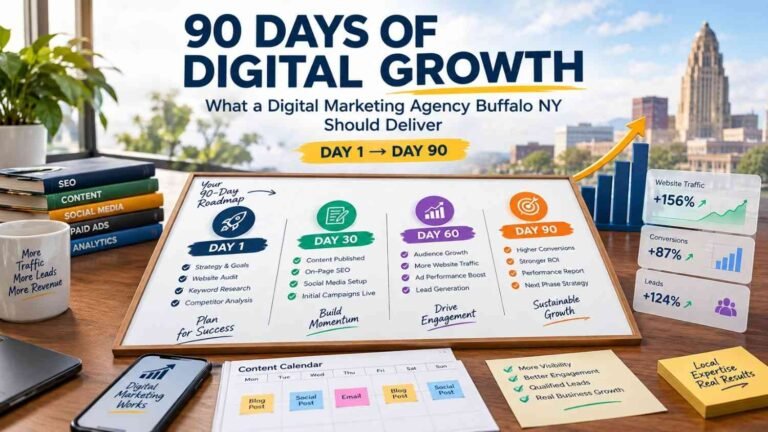
A 90-Day Plan for Turning Search Demand Into Leads
It’s not necessary that all aspects of a business’s marketing need to be changed all at once. A staged plan can be useful for identifying the greatest opportunities and for determining if the activity is yielding better results.
The activities will focus on the following periods:The periods will focus on the following:
| Period | Main focus | Practical activities |
|---|---|---|
| Days 1–30 | Research and measurement | Review current search visibility, identify important services, check landing pages, audit local business information, and verify conversion tracking |
| Days 31–60 | Improve the customer journey | Update priority service pages, improve contact forms, strengthen calls to action, address technical issues, and create content for clear search-intent gaps |
| Days 61–90 | Evaluate and refine | Review search performance, inspect lead quality, improve weak landing pages, refine paid campaigns if used, and establish ongoing reporting |
This timeline is a general guideline and not a promise. There are some changes that can be measured in a matter of days and others that can take longer for improvement in the organic search to be seen.
The key is dependent on the initial position. A company may require conversion enhancements if it has an established website, or it might require business information and quality service pages if it is a more recent business.
Final Thoughts
While Google search demand can benefit Buffalo businesses, there is more to consistent leads than ranking for popular keywords. It is important for businesses to know what searchers are looking for, offer a page that matches, provide easy ways to reach out, establish credibility, and respond to inquiries appropriately.
When done properly, a strategic mix of local search, valuable content, when relevant, paid search, conversion optimizations, and measurement techniques can help transform search traffic into real business. The strategy should be based on what services the company provides, who the customers are and whether the company can respond to new enquiries.
When taking care of a Digital Marketing Agency Buffalo NY that companies can rely on, you can help consolidate these activities. Qualified leads are more valuable than traffic, and by prioritizing them over traffic, businesses can make more informed marketing decisions and create a more pronounced lead-to-customer journey through Google.
Frequently Asked Questions
01 How can Buffalo businesses get more leads from Google?
Improve relevant service pages, local business information, calls to action, and enquiry tracking. Focus on attracting searchers whose needs match the services offered.
02 Is SEO or Google Ads better for local lead generation?
SEO can build organic visibility over time, while Google Ads can provide paid visibility. The right mix depends on goals, competition, budget, and timing.
03 What is a qualified lead?
A qualified lead is an enquiry that matches the business’s target customer, service offering, location, and other important requirements.
04 Why does my website get traffic but few enquiries?
Visitors may have mismatched intent, unclear contact options, weak trust signals, slow pages, or forms that are difficult to complete.
05 How important is Google Business Profile for local businesses?
It helps eligible businesses present accurate information, services, reviews, and contact details to people exploring local options on Google.
06 How should I choose keywords for a Buffalo business?
Prioritize relevant services, local intent, customer needs, competition, and conversion potential rather than choosing keywords based on search volume alone.
07 How can I measure leads from organic search?
Use Google Search Console for search performance, Google Analytics 4 for configured website conversions, and a lead tracker for enquiry outcomes.
08 How long does SEO take to generate leads?
Timing varies by competition, website condition, content quality, and demand. Some improvements appear earlier, while meaningful organic growth can take months.
09 Should every service have its own landing page?
Important services often benefit from dedicated pages when each has distinct customer needs and enough useful information to justify a separate page.
10 What should I ask a digital marketing agency before hiring it?
Ask about strategy, reporting, conversion tracking, account ownership, campaign costs, deliverables, communication, and how success will be measured.