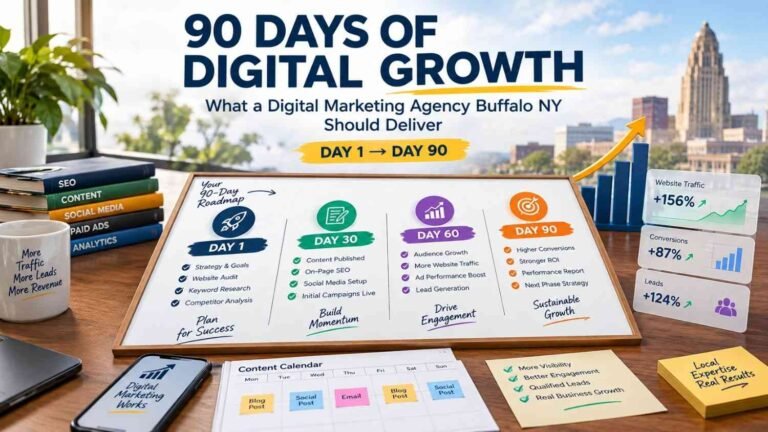


Buffalo NY digital agency marketing cost and time period for small businesses can vary depending on business goals, competition, current online visibility, and the marketing channels being used. A local contractor looking for more phone calls will need a different strategy from an online store targeting customers across New York. For this reason, a marketing budget should be based on specific business goals rather than an arbitrary monthly amount.
As a small business in Buffalo, digital marketing offers ways to reach customers via SEO, Google ads, social media, content marketing, email marketing and local search. But these channels don’t yield immediate results. With paid advertising, you can get traffic coming in shortly after you launch your website, and with SEO, it can take a few months of consistent effort.
Understanding Digital Agency Marketing Cost, the realistic timelines, and the way Digital Agency Marketing works in Buffalo NY can help business owners pick a suitable digital marketing strategy and check the various digital marketing agencies Buffalo NY.
Why Digital Marketing Is Different for Small Businesses
Small businesses typically don’t have the same advertising budgets as large businesses, which means they must make more targeted marketing decisions. Rather than trying to be present on all platforms, businesses can target customers who will search and convert on the platform that has the highest likelihood of reaching them.
A Buffalo roofing, plumbing or landscaping firm can gain a great deal from local search engine marketing and Google Ads, as people tend to look when they need the services that the company is providing. Social media, local search visibility, reviews, and promotions are more effective for restaurants, salons, retail stores, and other businesses that need their storefronts to be visually appealing.
Therefore, the journey of digital agency marketing for small Businesses starts with understanding customer behavior instead of just marketing trends.
What Does a Digital Marketing Agency Do?
A digital agency assists businesses in reaching potential customers and converting online interest into tangible business opportunities.
Services may include:
- Search engine optimization
- Local SEO
- Google Ads
- Social media marketing
- Content creation
- Email marketing
- Website optimization
- Reputation management
- Conversion optimization
- Analytics and reporting
A professional agency should also evaluate what marketing efforts are actually doing to get calls and inquiries, appointments, and purchases, or any other valuable action.
Why Local Digital Marketing Matters in Buffalo
When customers need local services, they prefer that the company be nearby. If someone is looking for a roofer, attorney, landscaper, restaurant, dentist, mechanic, or HVAC company, they might be looking for a Buffalo roofer or one in the community nearby.
Depending on the company’s actual service area, campaigns can focus on communities in and around Buffalo that include, but are not limited to, Amherst, Cheektowaga, Williamsville, Tonawanda, Kenmore, West Seneca, Hamburg, Orchard Park, Lancaster, and Clarence. But having merely city names on website pages isn’t an effective local strategy.
Marketing locally means integrating relevant content, accurate business information, service pages, customer reviews, local search optimization, and a well-managed Google Business Profile.
Digital Agency Marketing Cost
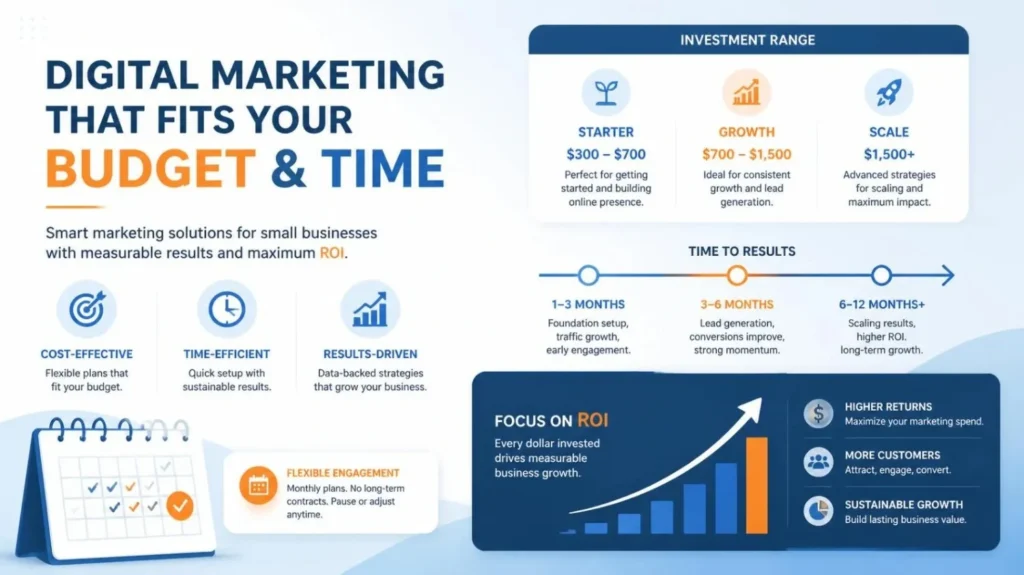
Digital Agency Marketing Cost is one of the primary factors taken into account by small businesses. There is no standard fee as it varies according to the competition, services provided, campaign size, website condition, geographic scope, etc.
Initial planning can be helpful using the following ranges:
| Marketing Service | Approximate Monthly Cost |
|---|---|
| Local SEO | $500–$2,000+ |
| Comprehensive SEO | $1,000–$5,000+ |
| Google Ads Management | $300–$2,000+ |
| Social Media Management | $500–$2,500+ |
| Content Marketing | $500–$3,000+ |
| Email Marketing | $300–$1,500+ |
| Multi-Channel Marketing | $2,000–$7,500+ |
| Website/Landing Page Project | $1,500–$10,000+ one-time |
These are general planning estimates and should not be interpreted as specific quotes for Buffalo businesses.
Advertising spend may also be independent of an agency’s management fee. Any business owner should verify this before accepting a package.
What Affects Digital Agency Marketing Cost?
There are a few things that will influence the amount that a small business might be required to invest.
Competition
Competitive industries can result in larger campaigns when operating a business. There can be some companies bidding for top value searches in legal services, roofing, real estate, healthcare, HVAC, home improvement, etc.
Website Condition
If a website is technologically not up to scratch, has slow loading times, low-quality content, or doesn’t work well on mobile devices, it needs to be improved before marketing campaigns are likely to be effective.
Number of Marketing Channels
Generally, SEO will cost you less than if you do SEO, PPC, social media, email, and content marketing at the same time.
Content Requirements
New service pages, location pages, blogs, landing pages, case studies, and additional content that is useful are all required for competitive campaigns.
Advertising Budget
Paid advertising requires additional management expenses as well as an investment in the advertising platform. These are listed separately by businesses when they are comparing proposals.
How Much Should a Small Business Spend?
In fact, companies should look at the cost of acquiring a customer rather than following another company’s marketing budget.
Important factors include:
- Average customer value
- Profit margin
- Lead-to-customer conversion rate
- Cost per lead
- Customer acquisition cost
- Repeat purchases
- Customer lifetime value
For instance, if the customer will be highly profitable, it might be acceptable to spend $100 to obtain a new customer. The value of the acquisition can be prohibitive for a firm that makes just a few dollars on each sale.
The goal should be profitable and not just marketing spend.
How Long Does Digital Marketing Take?
Since each digital marketing channel operates differently, there is no set time frame for digital marketing.
| Marketing Channel | Typical Time to Evaluate Results |
|---|---|
| Google Ads | 1–3 months |
| Social Advertising | 1–3 months |
| Local SEO | 3–6+ months |
| Organic SEO | 4–12+ months |
| Content Marketing | 6–12+ months |
| Email Marketing | 1–3 months |
| Conversion Optimization | 1–3+ months |
The timelines are indicative, not guaranteed, of when this will be accomplished. Results can be impacted by competition, budget, website authority, market demand, quality of the campaign, and previous marketing activity.
What Happens During the First Six Months?
If you know the timeline, you don’t have any unrealistic expectations.
Month 1: Research and Setup
The first month is typically dedicated to laying the groundwork.
Agency can do:
- Website audits
- Keyword research
- Competitor research
- Analytics setup
- Conversion tracking
- Google Business Profile reviews
- Technical SEO
- Advertising account analysis
Future marketing decisions are based on accurate tracking, especially since it is so important.
Months 2–3: Implementation
The agency starts to put the plan into practice.
Could be enhancements to service pages, publishing of content, running ads, optimizing local search profiles, building landing pages, optimizing calls to action, etc.
During this time, there may be leads trickling in from paid campaigns, and SEO will take even longer.
Months 4–6: Optimization
Once sufficient information has been gathered, marketers can be certain of which campaigns, keywords, locations, and services yield the greatest results.
The budget and strategy can be modified.
Buffalo NY Digital Agency Marketing Working Process
A clear Buffalo NY digital agency marketing working process should connect marketing activity with business outcomes.
Step 1: Understand the Business
The agency gets to know the company’s service and customers, geographic service area, competition, objectives and past marketing history.
Step 2: Audit Existing Marketing
The site, SEO, paid campaigns, local visibility, content, analytics and conversion tracking are assessed.
Step 3: Establish Goals
Goals need to be measurable.
Examples include:
- Increasing qualified leads
- Generating more phone calls
- Lowering CPA expenses
- Increasing appointments
- Improving online sales
- Growing local visibility
Step 4: Select Marketing Channels
Not all businesses require all the platforms. As a rule, it is the customer’s actions and business objectives that should determine an agency’s choice of media, not necessarily the largest media package.
Step 5: Improve Landing Pages
If visitors cannot easily understand what the service is or how to contact the company, then the traffic has been generated for nothing.
There should be clear information, strong calls to action, contact options, and relevant trust signals included on landing pages.
Step 6: Launch Campaigns
SEO, Google Ads, social ads, content, email or other selected strategies are used.
Step 7: Track Conversions
Call, purchases, appointments, requests for quotes, and form submissions are some of the important actions to be measured.
Step 8: Optimize and Report
Some campaigns may be tweaked if they are weaker; others may be prioritized if they are stronger. Reports should convey results in business terms relevant to the business and not leave the reader to glean the meaning from figures alone.
SEO vs. Google Ads for Buffalo Small Businesses
There are differences between the roles of SEO and paid search.
SEO
The primary goal of SEO is to build organic visibility in the long-term, rather than taking a shortcut.
Potential benefits include:
- Long-term search visibility
- Increased local discovery
- Traffic to multiple services
- Less dependence on paying for every website visit
However, SEO normally takes time.
Google Ads
Google Ads can offer quicker visibility since ads can start showing up almost immediately after campaigns are authorized.
Paid search can be a good thing for businesses that need immediate exposure. As a general rule, however, when advertising ends, traffic ceases.
Many small businesses adopt both strategies: PPC for short-term demand and SEO for long-term growth.
Why Conversion Rate Matters
Websites get more traffic, and more businesses think that means more customers. This is not always the case.
Suppose there are 2,000 monthly visitors to a site, with 1% converting to an inquiry. That produces 20 inquiries.
If the conversion rate is raised to 2%, the same number of visitors results in 40 enquiries. The business doubled the number of queries while maintaining the same amount of traffic.
Some of the improvements that can be made for conversion are:
- Better call to action
- Faster page speeds
- Simpler contact forms
- Stronger service descriptions
- Mobile-friendly layouts
- Reviews and trust signals
Therefore, a good digital strategy should take into account attracting visitors as well as converting them.
Seasonal Marketing in Buffalo
For many businesses in Buffalo there can be times of the year when demand shifts.
There’s a significant seasonal variation for landscaping, roofing, HVAC, snow services, home improvement, events, tourism, and retail.
Businesses need to have campaigns in place ahead of the time of peak demand.
This is especially so in the context of SEO, where it takes time to build up organic visibility.
Paid ads typically can adapt to seasonal shifts more rapidly, as budgets, ad copy and targeting can be adjusted more quickly.
How Small Businesses Can Build a Smarter Digital Marketing Plan
The optimal digital marketing strategy for small businesses isn’t always going to be the one that has the most channels. It’s the one linking together the available budget and the clear customer behaviour and measurable business goals. This is particularly vital when collaborating with marketing agencies Buffalo NY because a local business may not have enough resources to afford to waste cash on campaigns that aren’t bringing them success.
The first step towards a smarter plan is to determine which services and/or products are most profitable. A business does not need to market all services the same, they can begin by marketing the services that generate the strongest revenue opportunity.
For instance, a company has ten services, but only three service types consistently produce high value for customers. Focusing on those services can lead to a more effective use of the marketing budget.
Focus on High-Intent Customers First
All website visitors are not equal.
A visitor reading an informational blog post may have very different intent from someone searching for an immediate local service.
- “emergency roofer Buffalo”
- “dentist near me”
- “landscaping company Buffalo NY”
- “best family lawyer Buffalo”
- “HVAC repair near me”
Sometimes, these searches are signs of greater buying interest.
When it comes to digital agency marketing for small Businesses, it could be beneficial to focus on high-intent customers as the business might not be able to afford to target every keyword.
An agency can target search terms that indicate that customers are in a more advanced stage of the sales process and develop landing pages, ads, and SEO tactics around these search terms.
Build Marketing Around the Customer Journey
When customers find a business, they don’t always buy right away.
The general customer journey might be as follows:
Search → Website Visit → Review Check → Service Comparison → Contact → Purchase
Each stage should be assisted by a marketing strategy.
For instance, they can help customers find the business, and reviews and case studies can boost trust. From here, a visitor can be encouraged to call or request a quote, or schedule an appointment on a well-designed landing page.
This is because businesses can only attract traffic, but not necessarily retain it later in the purchasing journey.
Use Reviews as Part of the Marketing Strategy
Online reviews can have a significant effect on whether or not prospective customers reach out to a local business.
A firm that has a lot of new and detailed reviews is likely to have more credibility than a company that has few or no reviews.
A consistent review-request process should be developed by a small business after successful transactions.
If you send a follow-up e-mail, make sure it includes these details:
- Sending a follow-up email
- Sending a text message
- Providing a direct review link
- Asking satisfied customers after project completion
- Training employees to request feedback naturally
As customers tend to read through reviews before taking the first step, a good reputation boosts the performance of paid advertising, local search, and SEO efforts.
Improve Lead Quality, Not Just Lead Quantity
Increased lead generation doesn’t necessarily translate to improved marketing.
If the majority of the company’s leads are from people looking for services that it does not offer, or are from customers who live outside of the service area, then these leads have little value. The quality of the lead should thus be monitored periodically.
Using the following tools can enhance the quality of your leads:
- More specific keywords
- Clear service descriptions
- Geographic targeting
- Qualification questions on forms
- Accurate pricing guidance
- Negative keywords in paid campaigns
- Dedicated landing pages
It’s better to have a few qualified leads than a bunch of queries that have nothing to do with your product.
Track Phone Calls as Well as Website Forms
Many of the local customers prefer to call rather than fill out the online form. This is especially frequent with emergency or high-priority services. When a company only monitors online forms, it might be underestimating the effectiveness of the marketing campaign.
Call tracking can help you figure out:
- Which advertisements generate calls
- Which landing pages perform best
- Which marketing channels produce inquiries
- When customers call most frequently
This means small businesses can get a more comprehensive view of the performance of marketing.
Review the Marketing Plan Every Quarter
Digital marketing cannot be stagnant throughout the year. The business and agency can review at quarterly intervals:
- Which campaigns generated the best leads
- Which services were most profitable
- Which pages increased traffic
- Which advertisements underperformed
- Whether customer demand has changed
- Whether budgets should be reallocated
The priorities for a contractor in spring and summer could be different from winter and retailers might require more intensive campaigns around key buying events. The strategy is kept in line with the actual business environment through regular review.
Build an Owned Customer Database
Companies tend to invest a lot of money to get new customers, but fail to maintain them after they buy once. This can be reduced by building an email or customer database.
Businesses can communicate via email marketing with customers with the following:
- Seasonal reminders
- Service updates
- Promotions
- Educational tips
- New products
- Maintenance reminders
- Referral offers
This establishes a marketing funnel that is not entirely reliant on search engines or social media. Repeat sales and referrals from customers can be an important source of sales for many small businesses.
Think Long Term, but Measure Short Term
A solid marketing strategy is a mix of short-term and long-term objectives.
These are the short-term indicators:
- Leads
- Calls
- Cost per click
- Conversion rates
- Bookings
These include longer-term indicators such as:
- Organic visibility
- Review growth
- Customer retention
- Brand recognition
- Lower acquisition costs
- Increased lifetime customer value
Small businesses need to take both types of results into account when assessing Digital Agency Marketing Cost. Any campaign should provide useful short-term information and should steadily increase long-term marketing resources.
It is not just a matter of spending more money on marketing. It’s to develop a system that becomes more effective, quantifiable, and beneficial as the business expands.
Final Thoughts
Successful Buffalo NY digital agency marketing starts with choosing strategies that match the company’s goals, customers, competition, and available budget. Small businesses do not necessarily need to invest in every digital channel. They need to focus on the channels most likely to generate valuable customer actions.
Digital Agency Marketing Cost should also be evaluated alongside lead quality, conversion rates, customer value, and potential returns rather than the monthly price alone. A cheap campaign that produces no qualified customers can ultimately be more expensive than a larger investment that consistently generates profitable business.
Time expectations matter as well. Paid advertising can generate visibility quickly, while SEO, local search optimization, content marketing, and reputation building generally require a longer commitment.
By understanding the Buffalo NY digital agency marketing working process, monitoring meaningful performance metrics, and choosing the right strategy, digital agency marketing for small businesses can become a measurable part of long-term growth rather than simply another monthly business expense.
Frequently Asked Questions
01 How much does digital marketing cost for a small business in Buffalo?
Costs may range from several hundred to several thousand dollars monthly depending on services, competition, campaign size, and advertising requirements.
02 How long does SEO take?
Initial improvements may appear within several months, while competitive campaigns can require six to twelve months or longer to develop substantially.
03 Can digital marketing work with a small budget?
Yes. Small businesses can prioritize the marketing channels most likely to reach customers rather than trying to use every platform.
04 Is SEO better than paid advertising?
Neither is universally better. Paid advertising offers faster visibility, while SEO focuses on building longer-term organic search visibility.
05 Is advertising spend included in agency pricing?
Not always. Many agencies charge management fees separately from the amount paid directly to Google, Meta, or other advertising platforms.
06 What results should a digital agency report?
Useful reports should cover leads, conversions, cost per lead, customer acquisition, campaign performance, and changes made during the reporting period.
07 Does every small business need social media marketing?
No. Platform selection should depend on where the company’s customers spend time and how they research or purchase products and services.
08 Why does local SEO take several months?
Competition, website authority, content quality, technical performance, reviews, relevance, and other local search factors can influence the timeline.
09 How often should a digital marketing campaign be reviewed?
Performance should be monitored regularly, with larger strategic decisions made after enough reliable data has been collected.
10 How should I compare digital marketing agencies?
Compare their strategy, transparency, reporting, relevant experience, pricing structure, measurement methods, communication, and understanding of your business goals.