
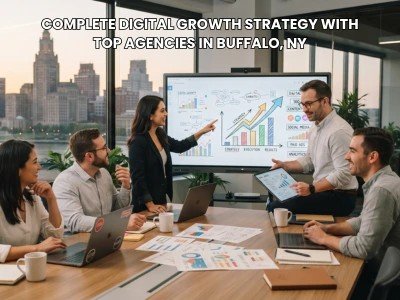
Complete Digital Growth Strategy with Top Agencies in Buffalo, NY starts with understanding that online growth rarely comes from a single marketing channel. Businesses need a connected strategy that attracts the right audience, builds trust, converts visitors into customers, and encourages long-term relationships. Working with a professional digital marketing agency Buffalo, NY businesses can partner with may bring SEO, paid advertising, content, social media, website optimization, analytics, and conversion strategy together under one plan.
The challenge is not just for local businesses to get more traffic on their website. The actual goal is to bring in those who will be customers. A professional marketing agency Buffalo, NY can look at the different digital platforms and know which ones to invest in, monitor the performance, and tweak the campaigns based on the measurable business outcomes.
This guide covers how Buffalo businesses can create a holistic digital marketing strategy without relying on one specific marketing tactic.
What Is a Digital Growth Strategy?
Digital growth strategy is a well-defined plan that involves leveraging online platforms to attain business objectives. Growth strategy entails integrating SEO, social media, advertising, and content as one.
For example:
Google Search → Service Page → Helpful Content → Contact Form → Follow-Up → Customer
Another trip might be to:
Social Media Ad → Landing Page → Email Signup → Follow-Up Campaign → Purchase
Every channel plays a certain role.
A whole strategy can be:
- Search engine optimization
- Local SEO
- Paid search
- Social media marketing
- Content marketing
- Website development
- Conversion optimization
- Email marketing
- Reputation management
- Analytics
The mix will vary based on company, audience, competition, and budget.
Step 1: Define Clear Business Goals
It’s important to start with business goals, not any specific platform.
Determine the goals of the company before determining the amount of money to invest in Google Ads, SEO, or social media.
Goals might include:
- Generate qualified leads
- Increase online sales
- Book more appointments
- Increase phone calls
- Develop new products for new markets
- Promote a new service
- Improve local visibility
- Increase repeat purchases
If possible, goals should be measurable. The term “get more traffic” is vague.
The marketing team now has a more definite goal: “Increase qualified website inquiries from Buffalo-area customers.”
A digital marketing agency Buffalo, NY can then choose the channels that will help them achieve that goal.
Step 2: Understand Your Ideal Customer
Attempting to target everybody means they could be less focused. Companies need to be aware of their target audience and their needs.
You can provide the following useful customer information:
- Location
- Common problems
- Purchase motivations
- Budget considerations
- Preferred communication methods
- Frequently asked questions
- Factors influencing decisions
A roofing company, restaurant, law firm, e-commerce store, and B2B software provider will naturally have very different audiences.
Understanding those differences helps agencies create more relevant messaging.
Step 3: Map the Customer Journey
It doesn’t take many ads to convince customers that they must have a product. They can touch a company several times.
For example, a potential customer could:
- Find the company through Google.
- Read a service page.
- Leave the website.
- See the brand again on social media.
- Read customer reviews.
- Return through a branded search.
- Submit an inquiry.
The entire path must be taken into account when developing a marketing strategy. This will stop businesses from wrongly believing that the last marketing touchpoint is where they should give credit.
Step 4: Audit the Current Digital Presence
Prior to launching new campaigns, an agency should know what is in place.
The digital audit might take a look at:
- Website performance
- Existing rankings
- Google Business Profile
- Paid campaigns
- Social accounts
- Content
- Analytics
- Conversion tracking
- Competitor visibility
The aim is to understand strengths, weaknesses, and missing opportunities. A company might determine that it’s getting a lot of traffic, but it’s not converting it to sales. Under those circumstances, the improvement of the website can be more beneficial than an immediate increase in advertising expenditures.
Step 5: Build a Strong Website Foundation
The website is frequently a part of a digital growth strategy. It could be as a result of SEO, paid ads, social media, or emails. Poor performance of the website will have a negative impact on marketing efforts.
A good business website will typically:
- Mobile-friendly
- Fast
- Easy to navigate
- Secure
- Clear
- Conversion-focused
A visitor should get as quick an understanding as possible:
Who you are → What you offer → Who you help → What they should do next
Before boosting the spending on a website campaign, a professional marketing agency Buffalo, NY might take a look at the website.
Step 6: Improve Conversion Paths
Traffic isn’t valuable unless it leads to valuable business actions.
A conversion could be:
- Phone call
- Contact form
- Quote request
- Appointment
- Purchase
- Email signup
- Consultation booking
Each key page should offer a suitable pathway forward. For instance, a service page could have a prominent Request a Consultation button rather than users having to trawl the site for contact details. Eliminating needless friction can help businesses make more out of their traffic.
Step 7: Develop an SEO Strategy
Utilizing search engine optimization, companies can make their visibility more prominent when people are actively looking for information, products, or services.
SEO may include:
- Keyword research
- Technical SEO
- Service-page optimization
- Internal linking
- Content development
- Local SEO
- Link acquisition
- Existing content updates
The objective is not to insert keywords into every paragraph. Modern SEO should match search intent to valuable content. If someone searches for a service, the page should clearly explain that service rather than forcing the visitor to read unrelated information.
Step 8: Focus on Local SEO
Local visibility is particularly crucial for businesses that cater to Buffalo residents.
Local SEO can feature:
- Google Business Profile optimization
- Accurate business information
- Local landing pages
- Customer reviews
- Local citations
- Relevant local content
- Location-focused keyword research
The location of a business should be clearly stated, but not overstuffed with location terms. For instance, a service contractor can talk about service areas and local customer needs without having to include “Buffalo NY” in all headings.
Step 9: Build Strong Service Pages
Blogs are a significant expenditure for many companies, and they fail to invest in their primary commercial pages. When visitors make their judgment on whether a company can solve their problem, they are likely to be on the service pages.
Any useful service page should have an answer to questions like:
- What is the service?
- Who needs it?
- What problems does it solve?
- What does the process involve?
- What makes the company different?
- Which locations are served?
- What should the customer do next?
A digital marketing agency Buffalo, NY can help optimize these valuable pages through keyword and customer research.
Step 10: Create Content for Different Buying Stages
Not all searchers will be ready to purchase straight away. Others are still investigating. Content could cover various points of the journey.
Awareness
Customer identifies a problem.
Content examples:
- Educational guides
- Beginner resources
- Common problem explanations
Consideration
The customer makes their own evaluations of potential solutions.
Useful content could be:
- Service comparisons
- Cost guides
- Buying guides
- FAQs
Decision
The customer is about to select a provider.
Useful pages could be:
- Service pages
- Case studies
- Testimonials
- Pricing information
- Consultation pages
This brings a content strategy that is linked to real customers.
Step 11: Update Existing Content
Growth doesn’t always have to be in digital content production. Sometimes there are already existing pages that can be improved.
A web page can be identified by an agency as being:
- Rank near page one
- Obtain impressions but few clicks
- Contain outdated information
- Have weak internal linking
- No longer match search intent
It might be more useful to update these pages than to post another unrelated blog entry. Content maintenance should thus be an integral aspect of a continuous SEO strategy.
Step 12: Use Paid Search for High-Intent Customers
Paid search can lead businesses to users who are actively searching for products or services.
Campaigns can target:
- Service keywords
- Location-based searches
- Branded searches
- High-intent commercial terms
But click costs do not always result in profitable customers. Campaigns are successful if they attend to:
- Keyword selection
- Negative keywords
- Ad messaging
- Landing pages
- Conversion tracking
- Bid strategy
A marketing agency Buffalo, NY should evaluate what happens after someone clicks the advertisement, not just how many clicks the campaign receives.
Step 13: Build Dedicated Landing Pages
It can lower the relevance of sending all paid campaigns to your home page. Businesses can have dedicated landing pages, where they can tailor the page to the advertisement.
A landing page can contain:
- Clear headline
- Service explanation
- Key benefits
- Trust information
- Simple contact form
- Strong call to action
The page should focus on the reason that the visitor clicked on it. Taking out all superfluous distractions can make the conversion roadmap clearer.
Step 14: Use Social Media Strategically
It is important to understand that businesses don’t have to be on all social networks.
But the more important question is:
- Brand awareness
- Customer education
- Community engagement
- Product promotion
- Website traffic
- Remarketing
Content should be platform and audience-appropriate. A professional services company might have a different use of social media than a restaurant or fashion retailer. The goal should be purposeful activity rather than posting simply to maintain a schedule.
Step 15: Combine Organic and Paid Social Media
Organic social media content can assist businesses in reaching their existing audience. Paid campaigns can help reach a wider audience and reach specific audience segments. Combining both makes for a better strategy.
Organic content can consist of:
- Company updates
- Educational tips
- Behind-the-scenes content
- Customer stories
Paid campaigns can be directed to:
- Lead generation
- Promotions
- Retargeting
- Product awareness
Agencies can try out various formats and analyze performance metrics to identify the messages that warrant further investment.
Step 16: Use Retargeting Carefully
A large number of visitors to the website do not convert. Retargeting can give businesses the opportunity to retarget specific visitors to their website via advertising platforms. For instance, a person could come to a service page and then leave without requesting a quote.
A later advertisement can remind this person about the business. When retargeting, the message should reflect the initial site interest. Companies should also think about any platform requirements and privacy laws that may apply to the use of audience tracking technologies.
Step 17: Build an Email Marketing System
Businesses can continue to communicate with those who have already expressed an interest in their business through email.
Campaigns may include:
- Welcome emails
- Educational content
- Product updates
- Promotions
- Appointment reminders
- Re-engagement messages
The more you segment your email subscribers, the more useful your emails can be. Different communication is required for a former customer, a new lead, and a customer who subscribes to your newsletter. This process can be simplified with automation.
Step 18: Strengthen Online Reputation
The reviews of their customers can have an impact on people’s buying decisions, especially with local businesses.
A reputation strategy could involve:
- Making review requests part of the customer process
- Monitoring new reviews
- Responding professionally
- Addressing recurring customer concerns
- Displaying genuine testimonials where appropriate
Businesses should avoid creating fake reviews or manipulating feedback. Authentic customer experiences provide more sustainable value.
Step 19: Connect Marketing With Sales
Marketing can’t stand alone from selling. Let’s say that an agency generates 100 leads, but it takes the business a few days to respond. It is easy to think that the campaign has failed because the problem is after lead generation, but that is not the case. Businesses should review:
Lead generated → Lead received → Response → Qualification → Sale
This can help determine your potential customer leakage points. Linking marketing and sales data can give a better understanding of the quality of campaigns.
Step 20: Use CRM Systems to Track Leads
Customer Relationship Management (CRM) systems can assist companies in managing enquiries and follow-ups.
CRM data can include information such as:
- Lead source
- Contact information
- Service requested
- Sales stage
- Follow-up activity
- Outcome
- Customer value
This info can be utilized to identify which marketing sources generate customers, not just traffic to your website. CRM data can be leveraged in a digital marketing agency Buffalo, NY, for better targeting of campaigns and budget allocation.
Step 21: Measure the Right KPIs
The measures of marketing performance should be linked to the business goals.
Some useful KPIs could be:
- Organic traffic
- Keyword visibility
- Cost per click
- Cost per lead
- Conversion rate
- Qualified leads
- Customer acquisition cost
- Revenue
- Return on ad spend
Not all metrics are meaningful. A campaign might have a lot of traffic, but get very few customers. Business results must not be lost.
Step 22: Improve Conversion Rates Before Increasing Traffic
Conversion rate optimization is an area that’s often overlooked. Suppose a website receives 5,000 visitors per month but generates only a small number of inquiries. The company may want to conduct a visitor analysis prior to making the decision to invest more in advertising to determine why visitors are failing to convert.
Possible problems include:
- Weak calls to action
- Slow pages
- Confusing forms
- Poor mobile experience
- Limited trust information
- Unclear service descriptions
A better outcome in these areas could be achieved with the same or a lower level of traffic.
Step 23: Use Competitor Research to Find Gaps
Competitor Analysis should offer opportunities for differentiation, not a call to copy.
A marketing agency can review the following:
- Competitor rankings
- Paid keywords
- Content topics
- Service pages
- Customer reviews
- Website experience
The most helpful question:
What are competitors failing to provide?
Maybe the rivals lack good FAQs, have poor mobile experiences, little educational content or confusing information about their service. Those gaps can be used as opportunities for differentiation.
Step 24: Create a Testing Culture
Digital marketing strategies should continually change based on what is working and what isn’t.
Agencies can test the following variables:
- Ad headlines
- Calls to action
- Landing pages
- Email subject lines
- Form length
- Content topics
Testing should be directed to actual business improvements, not changing things at random. However, the outcomes can inform choices in the future. Many small improvements can add up over time.
Step 25: Allocate Marketing Budget Based on Performance
Marketing budgets can’t just be the same as the year before. Agencies have the ability to compare channels for performance and business needs.
For example:
| Channel | Primary Purpose | Common Measurement |
|---|---|---|
| SEO | Long-term search visibility | Organic leads |
| Paid Search | High-intent acquisition | Cost per lead |
| Social Media | Awareness and engagement | Reach/conversions |
| Retention and nurturing | Clicks/conversions | |
| Content | Education and organic growth | Traffic/leads |
| CRO | Improve existing traffic value | Conversion rate |
Then businesses can grow, shrink, or rearrange their investment, using evidence.
Why an Integrated Strategy Works Better
One of the best benefits of having a full-service marketing agency Buffalo NY is that it can link several channels.
Consider this journey:
SEO article → Website visit → Retargeting ad → Service page → Email follow-up → Consultation
Every channel has a different contribution.
SEO creates discovery.
The website offers information.
Retargeting maintains awareness.
Email continues communication.
When it comes to conversion optimization, it’s easier to take action.
If agencies look at the whole experience, they will be able to see where they can make improvements.
Final Thoughts
A complete digital growth strategy is not about being everywhere online. It is about choosing the right channels and making them work together toward measurable business objectives.
Working with a professional digital marketing agency Buffalo, NY can help businesses connect SEO, paid advertising, content, social media, email, website optimization, analytics, and conversion strategy. Instead of measuring success only through rankings, clicks, or followers, companies can focus on qualified leads, customers, revenue, and sustainable growth.
The right marketing agency Buffalo, NY should also be willing to change direction when data shows that something is not working. Successful digital marketing requires continuous testing, measurement, and improvement rather than following the same plan indefinitely.
For Buffalo businesses planning their next stage of growth, the strongest starting point is understanding the customer, establishing clear goals, strengthening the website, tracking meaningful conversions, and investing in channels based on evidence. When these elements work together, digital marketing becomes more than promotion; it becomes a structured system for attracting, converting, and retaining customers.

Frequently Asked Questions
01 What does a digital marketing agency Buffalo, NY do?
A digital marketing agency may provide SEO, paid advertising, social media, content marketing, website optimization, email marketing, analytics, and conversion services.
02 Why should Buffalo businesses use multiple marketing channels?
Different channels reach customers at different stages, from initial awareness and research to comparison, purchase, and retention.
03 Is SEO or paid advertising better?
Neither is automatically better. SEO can support long-term organic visibility, while paid advertising can provide more immediate targeted exposure.
04 How can local SEO help Buffalo businesses?
Local SEO can improve visibility when nearby customers search for relevant businesses, services, or products.
05 Should small businesses hire a marketing agency Buffalo, NY?
An agency may be useful when a business needs specialized skills, lacks internal resources, or wants a coordinated strategy across several digital channels.
06 How should digital marketing success be measured?
Measure meaningful outcomes such as qualified leads, sales, conversion rates, customer acquisition costs, and revenue alongside traffic and visibility metrics.
07 How important is website design for digital marketing?
Very important. Most campaigns eventually direct potential customers to a website or landing page, so usability and conversion design can directly affect results.
08 How often should a digital strategy be reviewed?
Performance should be monitored regularly, while larger strategic reviews can evaluate whether budgets, channels, audiences, and goals still align.
09 Can digital marketing guarantee business growth?
No agency can responsibly guarantee specific results. Performance depends on competition, budget, execution, customer demand, sales processes, and many other factors.
10 What should I look for in a Buffalo digital marketing agency?
Look for transparent reporting, relevant expertise, clear strategy, realistic expectations, measurable goals, good communication, and an understanding of your business model.