

From Idea to App Store: What to Expect From an App Development Agency Buffalo, NY involves much more than simply turning an idea into code. An app development project usually includes several important stages, such as planning, research, design, development, testing, launch preparation, and ongoing improvements. Understanding these stages can help businesses know what to expect when working with an app development team and prepare for the journey from an early concept to a mobile product that is ready for users.
It’s easier to plan an app project and communicate with a project development team if businesses have a clear understanding of this process in Buffalo. No matter what the objective is, be it a customer-facing mobile app, an internal business utility, an e-commerce app, or a service-based platform, understanding what occurs at each step helps in having realistic expectations.
Understanding the App Idea
The first step typically starts with an idea. Here, the idea can be straightforward, like a mobile application where users can schedule appointments, place orders, send messages to a company, or access their schedules.
Before the beginning of development, the team that will bring the app to life needs to get a grip on what the app should do. This involves a discussion of business issues, target users, core features, and expected results.
The following questions may be asked by a development agency:
- Who will use the app?
- What problem will the app solve?
- What are the most important features?
- Will users need to create accounts?
- Will the app require payments?
- Does it need notifications?
- Will it connect to an existing website or system?
- Should it work on both iOS and Android?
- What is the expected launch timeframe?
These questions are intended to help take an idea and make it more of a usable project plan.
Defining the Target Users
Any application should be developed for its end-users. Before they design the interface, a development team can help a business determine which are the primary user groups.
For instance, a local service company might require an application for its clients that would enable them to schedule appointments. That company might also require an administrative control panel to manage such appointments by employees.
Both these users have different needs. Customers might want simple booking screens and employees might want dashboards, scheduling tools, customer data and status updates.
If these differences are understood early, there will be no unnecessary features and complicated screens later in the project.
Turning Features Into a Project Scope
After the initial concept, it’s time to determine the contents of the first version of the application.
There are a lot of ideas that many businesses have. But attempting to add as many features as possible to the initial version can also be costly and time-consuming.
An App Development Agency Buffalo, NY companies work with will be able to split features into the various categories as follows:
| Feature Type | Examples |
|---|---|
| User accounts | Sign-up, login, password reset |
| Communication | Chat, messages, email notifications |
| Payments | Card payments, subscriptions, invoices |
| Location | Maps, directions, location services |
| Scheduling | Appointments, bookings, reminders |
| Content | Articles, images, videos, announcements |
| Business tools | Reports, dashboards, customer management |
The team can then identify the features that are necessary for the initial launch and which ones can be added in the future.
Creating a Minimum Viable Product
A Minimum Viable Product, or MVP, is an early release with the essential functionality to accomplish its primary purpose.
For instance, an app that allows restaurants to place orders might start with:
- Customer registration
- Menu browsing
- Cart
- Online ordering
- Payment
- Order confirmation
- Basic order tracking
Later releases may have advanced features like advanced loyalty systems, personalized recommendations, etc.
An MVP can help a business get to market faster and gather user feedback on the initial release before adding more features.
Planning the App Structure
The structure of an application should be known before designing application screens.
This may involve developing a user flow or sitemap to exhibit the way users navigate through the app.
For example:
Login → Home → Service Selection → Booking → Payment → Confirmation
A good structure allows users to complete their tasks in a non-trapping way.
It also provides the developers with insight into how the various screens and functions must communicate with each other.
Designing the User Experience
User experience, or UX, is the usability of an app from a user’s point of view.
A development agency can initially produce wireframes indicating the very fundamental design of essential displays. These wireframes can be a good way to point out issues before visualization and development occur.
For instance, a booking application may have to have various screens for:
- Selecting a service
- Choosing a date
- Selecting a time
- Entering customer details
- Confirming the appointment
The objective is that the process would be comprehensible and efficient.
Creating the Visual Design
Once the user experience is designed, it is possible to create the look and feel of the application.
This may include:
- Brand colors
- Fonts
- Buttons
- Icons
- Images
- Forms
- Navigation elements
- Cards and menus
The design should be consistent with the brand of the business and should be easy to use on smaller screens.
While a professional look is helpful, remember to still keep usability in mind. If there is not enough information to find or if basic actions are difficult to perform, the attractiveness of the screen is not enough.
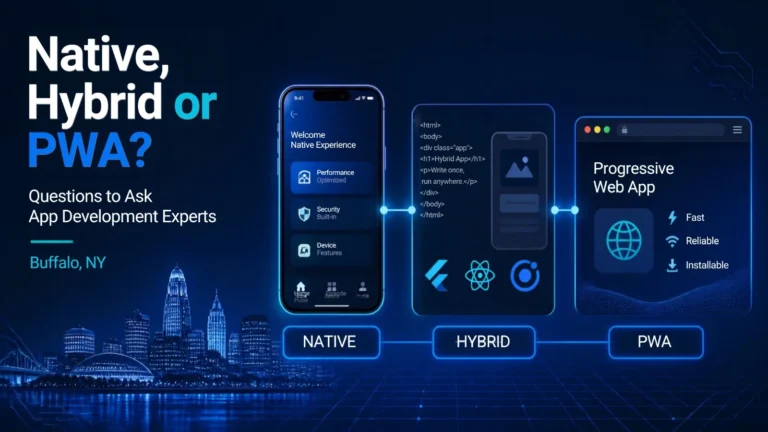
Choosing the Right Technology
Depending on the requirements, the technology employed for the development of an app may differ.
Some applications can be built for both iOS and Android, whereas others might be created for each of the operating systems.
The choice of technology can be influenced by the following factors:
- Required features
- Performance expectations
- Development budget
- Timeframe
- Existing systems
- Future maintenance
- Security requirements
- Expected number of users
The development team should not just choose a platform for its popularity, but explain why it is a suitable platform.
Developing the Mobile Application
Once the scope and design are approved, development can start.
The developers typically develop the app in parts instead of developing it all in one.
For instance, development could begin by:
- User registration
- Login
- Home screen
- Main functionality
- Data management
- Notifications
- Payments or other integrations.
- Administrative features
The development team may give progress reports or working versions to review during the development process in accordance with the project.
This is a chance for the business to give input as the project is still in development.
Building the Backend
For many mobile apps, you need more than just the application that’s installed on a phone. They may also require a back-end system to handle and store the information.
Let’s say that an app requires a backend to manage:
- User accounts
- Orders
- Appointments
- Product information
- Payments
- Messages
- Notifications
- Reports
Communication between the mobile application and the backend is done via APIs. These connections enable information to flow from the user’s device to the business’s systems.
Security should also be taken into account when developing the backend for applications that process information or payments from customers.
Connecting Third-Party Services
Certain apps depend on other services to function in a particular way.
Examples include:
- Payment gateways
- Mapping services
- Email platforms
- SMS services
- Analytics tools
- Cloud storage
- Authentication services
- Customer relationship management systems
The development agency can assist in identifying the integrations needed and setting up the relationships between the app and the required integrations.
There are also costs, limits, and technical requirements that can be imposed by third-party services, so it is important to be aware of these prior to launch.
Testing the Application
Testing is a significant portion of a development process. An app can have a complete end-to-end flow and can still have technical issues that impact the user.
Developers and Testers can verify:
- Buttons and links
- Forms
- Login processes
- Data submission
- Payments
- Notifications
- Screen layouts
- Internet connection behavior
- Error handling
- Different screen sizes
- Application performance
Testing should be carried out on a continuous basis, not just before launch.
Testing on Different Devices
Not all mobile users have the same mobile phone, OS version, screen size, or hardware.
If an app functions on one device, it may not function on another.
Testing on multiple devices and operating systems can be useful to detect problems with:
- Screen layouts
- Font sizes
- Touch controls
- Performance
- Permissions
- Camera access
- Location services
- Notifications
This is especially crucial if an application is going to be aimed at a wide consumer base.
Security and Data Protection
Security is an important aspect of any app project, so it should be factored in right from the start.
Applications can store any kind of sensitive data, like names, email addresses, phone numbers, addresses, payment details, or business-related data.
A development team can take steps like:
- Secure authentication
- Encrypted communication
- Access controls
- Secure API connections
- Input validation
- Password protection
- Secure data storage
- Regular dependency updates
Businesses also need to be aware of the information that their application is gathering and how that information is being stored and used.
Preparing for App Store Submission
If the app is ready for the public, it’s not necessarily completed when it’s developed.
The development team can assist pre-launch with the information needed for App Store submission.
This can include:
- App name
- App description
- App icon
- Screenshots
- Promotional images
- Privacy information
- Age rating
- App category
- Developer account information
Apple and Google have their own process and guidelines for submission. If an app is not compliant with the requirements, then it requires changes.
Preparing for the Google Play Store and Apple App Store
Any business that wants to reach users on both major platforms should take the needs of both platforms into account.
Submission and policies vary between the Apple App Store and the Google Play Store.
A well-experienced development team will be able to coordinate the technical files and record the information required for submission.
This can include submitting the application, filling out the information about the application in the store, sending it to the store for review, and answering any questions they may have during the process.
Launching the App
After going through the required review, the application can be made available to the users.
But launch day need not be the end of the project.
The team may be required to track:
- Downloads
- Crashes
- Login problems
- User feedback
- Performance
- Server activity
- Reviews
- Feature usage
Problems that were not seen during internal testing may be picked up with early monitoring.
What Happens After Launch?
After being published on the App Store and Google Play, an App must be maintained.
Mobile operating systems are regularly updated, and third-party services can change their requirements. There might be updates that need to be done for security reasons.
Post-launch activities may involve:
- Bug fixes
- Security updates
- Performance improvements
- Operating system compatibility
- New features
- Design improvements
- Analytics reviews
- User feedback analysis
For that reason, a business should talk about the maintenance that needs to be carried out after the initial project is finished.
Measuring App Performance
Once businesses launch their products, they should pay attention to something else besides the number of downloads.
Helpful measurements can be:
- Number of active users
- User retention
- Session duration
- Conversion rates
- Completed bookings
- Completed purchases
- App crashes
- Uninstall rates
- Feature usage
The appropriate metrics will vary based on the application’s intended use. Examples include a booking application that targets completed bookings, and an e-commerce application that targets purchases and completion of the checkout process.
Why Local Business Knowledge Can Matter
It might be beneficial to communicate directly with an App Development Agency Buffalo, NY business, particularly for those catering to customers in Western New York.
Specific features could be required based on a local business’s unique customer base, service area, business processes, or current technology.
For instance, an enterprise service offering that is based in Buffalo can require its application to integrate with the scheduling system, customer records, payment options, or location-specific capabilities of the city.
Business knowledge is essential and cannot be replaced by technical skills, but it can help to ease communication and project planning.
How Businesses Can Prepare Before Hiring an Agency
You do not have to know all the technical details when you approach the app development team.
It is helpful to have a simple project sketch to help in the initial conversations, though.
Prepare information such as:
- The main purpose of the app
- Target users
- Key features
- Examples of similar apps
- Preferred platforms
- Expected budget
- Desired launch timeframe
- Existing website or software
- Branding materials
If the agency can get the idea in a simple document, then it will be a good starting point.

Questions to Ask an App Development Agency
Businesses can ask questions before the launch of a project concerning the development process.
Useful questions include:
- What development approach do you recommend for this app?
- How will the project scope be defined?
- Who will handle UX and UI design?
- How often will we receive project updates?
- How will testing be managed?
- What third-party services will the app require?
- Who owns the source code?
- How will security be handled?
- What happens if the app needs additional features?
- What support is available after launch?
Clarifying responses will provide clarity to the business about the project.
Understanding App Development Costs
The complexity of their application, not just the number of screens, is what matters when it comes to the cost of developing an app.
Some of the factors that may impact the cost are:
- Number of platforms
- Feature complexity
- Custom design requirements
- Backend development
- Third-party integrations
- Payment functionality
- Security requirements
- Administrative dashboards
- Testing requirements
- Ongoing maintenance
If your app is just providing information, it might take a lot less work than a platform with payments, real-time communication, GPS, and different types of users.
It is advisable for businesses to ask for a detailed project scope to allow them to comprehend what they are getting into.
Common Mistakes Businesses Can Avoid
It is important to have a clear scope to start development; otherwise, it will lead to issues later in the development process.
Common issues include:
- Adding too many features at the beginning
- Not defining the target audience
- Ignoring user experience
- Underestimating testing
- Forgetting backend requirements
- Choosing technology without considering future needs
- Not planning for maintenance
- Failing to prepare app store information
- Expecting immediate user growth after launch
Although good planning doesn’t necessarily mean that an app project will go exactly as planned, it can help to minimize avoidable problems.
From an Idea to a Working Product
The journey from an app idea to an App Store release involves many stages. The process generally moves from idea → planning → user research → feature definition → UX/UI design → development → testing → submission → launch → maintenance.
| App Development Stage | What Happens |
|---|---|
| 1. Idea & Planning | Define the app purpose, business goals, target users, and expected results. |
| 2. Feature Definition | Identify essential features and decide what should be included in the first version. |
| 3. UX/UI Design | Create user flows, wireframes, screens, navigation, and visual design. |
| 4. Technology Selection | Choose suitable platforms, frameworks, backend technologies, and integrations. |
| 5. Development | Build the mobile application, backend, database, APIs, and required features. |
| 6. Testing | Test functionality, performance, security, different devices, screen sizes, and operating systems. |
| 7. App Store Submission | Prepare app information, screenshots, privacy details, icons, and submit the app for review. |
| 8. Launch | Publish the application and monitor downloads, crashes, reviews, and user activity. |
| 9. Maintenance | Fix bugs, improve performance, update security, maintain compatibility, and add new features. |
Every stage is a part of the product.
If your business is thinking of hiring an App Development Agency Buffalo, NY, knowing about the process can help make budget planning, content preparation, requirements communication, and development decisions a breeze.
It is not just about publishing an application – it is about a strong app project. It’s about designing a product to address a legitimate need, offer an intuitive user experience, be able to function effectively, and be able to evolve post-release.
Final Thoughts
From Idea to App Store: What to Expect From an App Development Agency Buffalo, NY is a process that involves much more than creating a mobile interface. Research, planning, design, development, testing, security, store submission, and ongoing maintenance all contribute to the final application.
Businesses that understand these stages can enter development with clearer expectations and make more informed project decisions. Whether the app is designed for customers, employees, bookings, sales, communication, or another business purpose, careful planning can provide a stronger foundation for the product from its first idea through its continued development.
FAQs
01 How long does it take to develop a mobile app?
The timeline depends on the number and complexity of features, platforms, integrations, design requirements, testing, and approval processes.
02 Should a business build an iOS or Android app first?
The decision depends on the target audience, business goals, expected users, and platform requirements rather than using one platform for every project.
03 Can an agency help improve an existing mobile app?
Yes. A development team can review an existing application and work on bugs, performance, design, security, compatibility, or additional features.
04 Does every mobile app need a backend?
No. Simple applications may work without a traditional backend, while apps involving accounts, online data, payments, or synchronization commonly require backend services.
05 Who provides the content for an app?
This depends on the project agreement. Businesses may provide product information, images, descriptions, policies, and other content, while the agency handles the technical implementation.
06 Can an app connect with existing business software?
Yes. An application can often connect with existing systems through APIs or other integration methods, provided the systems support the required connections.
07 What happens if users discover a bug after launch?
Bugs can be fixed through post-launch updates. The development team can investigate the issue, correct it, test the fix, and release an updated version.
08 Can new features be added after the app is launched?
Yes. Many applications are developed through multiple versions, allowing businesses to introduce new functionality based on user feedback and changing business requirements.
09 Do businesses need an app maintenance plan?
A maintenance plan can help keep the application compatible with new operating system versions, address technical issues, and support future improvements.
10 What should a business provide before development begins?
A business should ideally provide its main goals, target users, required features, branding information, existing systems, preferred platforms, budget expectations, and desired timeframe.