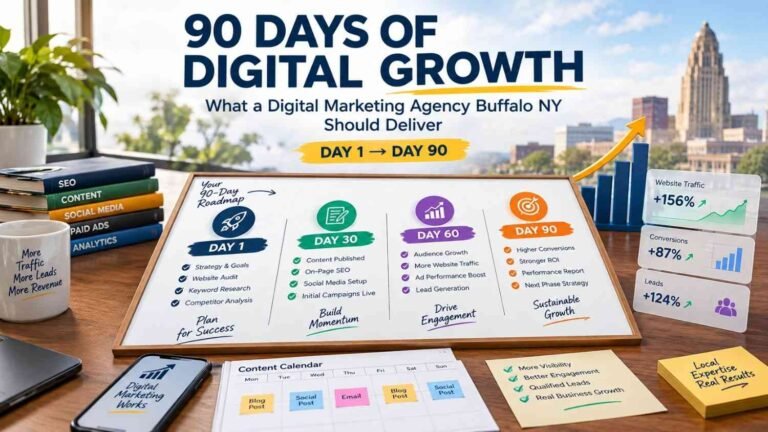


The blog tells about Why Data Wins: Lessons From a Data-driven Marketing Agency in Buffalo. Contemporary marketing has come way past assumptions and intuition. The successful businesses today are always based on data-first marketing strategies, which transform insights into action. A Data-driven marketing agency in Buffalo realizes that it is through quantifiable performance, actual customer behavior, and continuous optimization that growth can be achieved.
This article discusses the reasons why data wins in contemporary marketing, how analytics strategy determines business development, and the valuable lessons that companies can learn when implementing a data-first mindset.
The Shift From Guesswork to Data-First Marketing
Conventional marketing used to be based on guesses, gut feeling and general messaging. Although creativity remains important, modern business companies simply cannot afford to resort to guesswork.
Data-first marketing is the opposite of assumptions; it is a form of marketing that uses facts. Each click, search, and interaction will provide you with valuable insights into customer behavior. This data can be analyzed to show:
- What customers want
- Where they use the internet.
- What campaigns do we get leads from?
- What marketing channels bring revenue?
Businesses are no longer left to hope that campaigns are effective; rather, they must prove their effectiveness.
Why Data Wins in Modern Marketing
Information makes marketing predictable and scalable.
1. Data Removes Uncertainty
There is a constraint on marketing budgets, and the budgets may be wasted, thereby halting business growth. Data removes ambiguity by revealing the specific campaigns that are yielding results.
Businesses can identify:
- High-performing ads
- Effective keywords
- Strong audience segments
- High-converting landing pages
Marketing is no longer a gamble; it is an investment with this understanding.
2. Data Improves Targeting
Among the biggest lessons of any analytics strategy, there is the fact that not all audiences are equal.
Data helps businesses:
- Identify ideal customers
- Target audiences based on behavior.
- Personalize messaging
- Contact the buyers at the appropriate moment.
Targeted marketing leads to better engagement and higher conversions.
3. Data Enables Continuous Improvement
Success in marketing is not instant. It needs continual optimization.
The data enables marketers to:
- Run A/B tests
- Real-time campaign adjustment.
- Improve conversion rates
- Improve returns on investment.
One of the greatest benefits of a data-driven approach is constant enhancement.
The Role of Analytics Strategy
A good analytics plan makes sure that the data is gathered, examined, and utilized in proper ways.
Key Components of an Analytics Strategy
Data Collection
Tracking applications capture data on websites, advertisements, social media, and email programs.
Data Analysis
Raw figures are converted into valuable information that informs decision-making.
Data Application
The insights are utilized to enhance campaigns and create statistically significant growth.
Data are overwhelming in the absence of a strategy. Data is powerful with a strategy.
Lesson 1: Set Clear Marketing Goals
Data can only be valuable when it is attached to particular objectives. Effective campaigns start with quantifiable goals like:
- Increasing website traffic
- Generating leads
- Improving conversion rates
- Growing brand awareness
Measurable objectives make marketing activities focused and measurable.
Lesson 2: Track the Right Metrics
A lot of companies monitor such vanity metrics as likes or impressions. Although these figures are impressive, they do not necessarily translate into revenue.
An agency that relies on data is concerned with such metrics that matter:
- Conversion rate
- Cost per lead
- Customer acquisition cost
- Return on advertisement
- Lifetime customer value
These indicators demonstrate the actual contribution of marketing.
Lesson 3: Understand the Customer Journey
Customers do not make instant decisions. They would rather pass through a process that encompasses awareness, consideration, and decision processes.
Data assists companies in knowing:
- How they are discovered by customers.
- What they read.
- What are conversions caused by touchpoints?
Comprehending the journey enables businesses to direct customers more efficiently.
Lesson 4: Personalization Drives Engagement
One-to-one marketing can make a great difference.
Businesses can use data to:
- Recommend relevant products
- Send targeted emails
- Display personalized ads
- Create tailored content
Customers feel that they are understood when personalized, and trust and loyalty are enhanced.
Lesson 5: SEO and Data Work Together
The success of search engine optimization is based on information.
Analytics helps identify:
- High-performing keywords
- Website user behavior.
- Content opportunities
- Technical problems in rankings.
Data-first marketing and SEO combine to generate long-term growth.
Lesson 6: Paid Advertising Requires Data
Online advertisement sites produce enormous amounts of data.
This data assists marketers:
- Optimize ad targeting
- Minimize cost per click
- Increase conversions
- Improve ad creative
Paid advertising is costly and unpredictable without data.
Lesson 7: Content Marketing Should Be Measurable
The analytics are the best way to control the use of content marketing.
Data reveals:
- What the visitors are interested in.
- What articles turn readers into converts?
- Duration of stay on pages by users.
- Which contents are the leads?
This understanding can aid companies in producing effective content.
Lesson 8: Automation Enhances Efficiency
The data enable the marketing automation tools to enhance efficiency.
Automation can:
- Send targeted emails
- Score leads
- Schedule social posts
- Track campaign performance
Automation is time-saving and enhances accuracy.
Lesson 9: Data generates Competitive Advantage
Companies that make use of data have a competitive advantage.
They can:
- Identify trends early
- Quickly adapt to market changes.
- Outperform competitors
- Scale faster
Data-driven businesses make smarter choices and develop more steadily.
Lesson 10: Long-Term Growth Requires Consistency
The use of data in marketing is not a single initiative. It must be constantly monitored, tested, and improved.
The success in the long term is achieved due to:
- Consistent tracking
- Regular reporting
- Ongoing optimization
- Strategic planning
Unity transforms information into long-term development.
Common Challenges in Data-First Marketing
Despite its advantages, businesses are likely to have challenges, including:
- Data overload
- Lack of expertise
- Integrating multiple tools
- Interpreting complex analytics
These can be overcome by working with experienced professionals.
How Businesses Can Adopt a Data-First Mindset
To start their journey to data, companies can:
- Setting measurable goals
- Implementing tracking tools
- Monitoring key metrics
- Testing campaigns regularly
- Making decisions based on insights.
Little actions can bring big changes over time.
Building a Culture of Measurement
Responsibility is the largest change that the largest shift in data creates for marketing. All campaigns, channels, and tactics are now measurable. An agency that is based on data creates a culture in which everything has a definite result.
Instead of asking “Did this campaign feel successful?”, teams ask:
- What was the number of leads that we generated?
- How much did it cost to get?
- What channel had the highest conversion rate?
- What was the most effective messaging?
Such an attitude will guarantee that marketing budgets are not wasted and that, over time, results will keep on improving.
Turning Customer Data into Actionable Insights
Modern marketing produces enormous volumes of data on websites, advertisements, social networks, email, and CRM. Nonetheless, raw data itself cannot be useful without analysis and translation into action.
An analytics-based marketing agency in Buffalo considers analytics to detect trends like:
- Demographic and interests of the audience.
- Web behavior and patterns of navigation.
- Bottlenecks in the sales funnel.
- High-performing marketing channels
Such insights enable businesses to optimize strategies, cut wasteful spending, and concentrate on strategies that drive growth that can be measured.
The Power of Audience Segmentation
Customers are not all alike. Data assists marketers in subdividing audiences into valuable segments as per behavior, location, interests, and purchase history.
Segmentation enables businesses to:
- Personalize marketing messages
- Deliver targeted offers
- Improve engagement rates
- Increase conversion rates
To illustrate, a real estate company will need to market to first-time homeowners differently from investors of luxury property. Such a high degree of personalization will enhance the performance of the campaign significantly.
Data-Driven Content Marketing
Analytics is essential in helping content marketing to be much more effective. Rather than making assumptions about what audiences desire to read or watch, the marketers rely on the data to determine the topics and formats that spur interest.
Important data points are:
- Search terms and trends.
- Blog engagement metrics
- Video watch time
- Social media shares
By concentrating on issues that have already proven to be popular, companies can develop content that will generate traffic and establish authority in the sector.
Improving Paid Advertising Performance
One of the most quantifiable types of marketing is paid advertising. Data-driven agencies are always trying to improve campaigns to achieve better outcomes.
The important optimization strategies are:
- A/B testing ad creatives and headlines.
- Adjusting bidding strategies
- Determining well-performing audience segments.
- Tracking conversion paths
These are ongoing enhancements that make campaigns less expensive and more effective as time goes by.
Conversion Rate Optimization (CRO)
Traffic is not the whole marketing equation. It is also important to convert visitors into leads and customers.
Data assists in determining why visitors fail to convert by:
- Click tracking and heatmaps.
- Bounce rates
- Page load speed
- Form completion rates
Minor changes, like making forms less complicated or designing pages better, can greatly boost conversions without raising traffic.

Predictive Analytics and Forecasting
The prediction of future outcomes is one of the strongest benefits of data-driven marketing.
Predictive analytics helps companies:
- Predict sales and demand.
- Identify seasonal trends
- Plan marketing budgets
- Allocate resources effectively
This is proactive and assists companies in being ahead of the game and anticipating growth prospects.
Multi-Channel Marketing Attribution
It is uncommon to have customers convert in a one-time interaction. They can learn about a brand via social media, read the posts on blogs, follow advertisements, and get emails before purchasing.
Attribution models help data-driven agencies to know the contribution of each channel to conversions. This will make sure that marketing budgets are effectively distributed across channels that yield results.
The Importance of Marketing Dashboards
Transparency and decision-making require there to be clear reporting. An analytical marketing agency in Buffalo offers real-time dashboards to monitor key performance indicators.
Common metrics include:
- Website traffic
- Lead generation
- Conversion rates
- ROA spending.
- Customer acquisition cost
These dashboards enable business owners to be aware of the performance and make quick decisions.
Using AI and Automation
AI and automation have become potent in contemporary marketing.
Automation enables a business to:
- Send individual email campaigns.
- Score and nurture precede.
- Optimize ad bidding
- Provide dynamic content on websites.
AI helps to increase efficiency and make marketing campaigns work at their maximum.
Continuous Testing and Experimentation
Effective marketing does not rest on its laurels. Evidence-based agencies never stop testing new things and techniques.
Types of testing are:
- Landing page layouts
- Email subject lines
- Ad formats
- Pricing strategies
This experimentation makes sure that campaigns keep on improving and responding to the varying market conditions.
Building Long-Term Customer Relationships
Data not only assists in customer acquisition but also in retention. Following the customer behavior and interaction, the businesses will be able to create loyalty programs, tailored-made offers, and retention campaigns.
Customer retention can be a less expensive undertaking than acquisition and is an important consideration when it comes to long-term growth.
Aligning Marketing with Sales
Marketing and sales teams are interrelated through data, which creates mutual insights. Lead quality, conversion rates, and revenue attribution can be monitored by both teams.
This coordination enhances teamwork and makes marketing activities directly proportional to the expansion of the business.
Data Privacy and Ethical Marketing
With the increase in the significance of data, the use of data ethically is inevitable. By managing data in an open and secure way, a responsible agency will establish adherence to the privacy rules and gain the trust of the customers.
One important element in the establishment of long-term customer relations is trust.
Analytics Competitive Advantage
Companies that utilize data have a major competitive edge. They can react more rapidly to changes in the market, optimize campaigns within a short period of time, and make smarter strategic decisions.
Firms that neglect analytics run the risk of being left behind by other firms that are using data to spur growth.
Final Thoughts
The biggest thing that an agency like Data-driven in Buffalo has taught is that data wins. Companies that are based on analytics strategy and quantifiable insights make wiser decisions, minimize risks, and commit to steady growth.
Through data-first marketing, organizations can have a clear understanding, efficiency, and a competitive edge. In the modern online world, the victors are those businesses that are able to measure, learn, and optimize constantly.
FAQs
01 What is data-driven marketing?
Data-driven marketing uses analytics, customer insights, and measurable metrics to guide decisions. It replaces guesswork with evidence, helping businesses create targeted campaigns, improve results, and maximize return on marketing investment over time.
02 Why is data important in digital marketing?
Data helps businesses understand customer behavior, track campaign performance, and identify what works. It enables smarter budgeting, better targeting, and continuous improvement, ensuring marketing strategies produce consistent and measurable growth.
03 How does data improve advertising results?
Analytics reveal which ads perform best, which audiences convert, and where budgets are wasted. Marketers can optimize campaigns, test variations, and refine targeting, reducing costs while increasing conversions and overall advertising effectiveness.
04 What tools are used in data-driven marketing?
Common tools include website analytics platforms, CRM systems, ad dashboards, heatmaps, SEO tools, and marketing automation software. These tools collect, analyze, and visualize data to support better decision-making and campaign optimization.
05 How does audience segmentation help marketing?
Segmentation divides audiences into groups based on interests, behavior, or demographics. This allows businesses to personalize messaging, improve engagement, and deliver more relevant offers that increase conversions and customer satisfaction.
06 What is conversion rate optimization (CRO)?
CRO focuses on improving websites and landing pages so more visitors become customers. Using data, businesses test designs, messaging, and user experiences to remove barriers and increase conversions without increasing traffic.
07 Can small businesses benefit from data-driven marketing?
Yes, small businesses benefit significantly. Data helps them compete efficiently, focus budgets on high-performing channels, understand customers better, and achieve measurable growth without wasting limited marketing resources.
08 How often should marketing data be reviewed?
Marketing data should be reviewed regularly, often weekly or monthly. Frequent analysis allows businesses to spot trends, adjust campaigns quickly, and continuously improve performance before problems impact results.
09 Is data-driven marketing expensive to implement?
It can be cost-effective. Many analytics tools are affordable or free. The long-term savings from improved targeting, reduced wasted spend, and better campaign performance often outweigh initial setup costs.
10 What is the biggest advantage of data-driven marketing?
The biggest advantage is predictability. Businesses can track performance, forecast growth, and make informed decisions, turning marketing into a reliable and scalable driver of revenue and long-term success.